Motorcycle gear buying, decoded
Nine guides that together cover the complete motorcycle gear buying journey, from picking the right helmet certification to building your first $1,000 kit, adding an intercom once you're riding with a group, stepping up to dedicated adventure and dual-sport gear, the women's-specific gear playbook for female riders, and cold-weather heated gear (with the alternator-capacity warning small bikes can't ignore). Use this as the starting point; each step links into a deeper guide.
Nine guides, one buyer journey. We at ALLR have shipped a topic-deep guide for each of the questions motorcycle gear buyers actually ask — what certification matters, what shape your head is, how sizing translates across regions, when to buy cross-border, what a complete first kit costs, which intercom brand to pick once you ride with a group, what the full adventure / dual-sport ecosystem looks like once you outgrow street gear, what women's-specific gear actually means (it's pattern engineering, not a pink colorway), and how to extend the riding season into the cold months with heated gear (plus the alternator-capacity gotcha small bikes can't ignore). Read them in order if you're new, or jump straight to the one that matches your current question. Each spoke links back here, so you can navigate the cluster as a whole rather than a flat list of articles.
The journey at a glance
Nine steps, each with its own deep-dive guide. The order below moves from the most-foundational decisions (helmet certification, head shape) toward the most-specialized ones (intercom, ADV gear, women's-specific gear, cold-weather kit). If you're starting from scratch and have nothing yet, work through them in sequence. If you're shopping for a specific piece, the table below tells you which step covers your question.
| Step | Topic | Guide | Browse |
|---|---|---|---|
| 1 | Helmet certifications | ECE 22.06, DOT, Snell, FIM | Helmets |
| 2 | Helmet head shape | Head shapes by brand | Helmets |
| 3 | Cross-region sizing | EU vs US sizing | All categories |
| 4 | Cross-border buying | EU→CA · EU→US | Landed cost explained |
| 5 | Your first complete kit | Beginner kit under $1,000 | Helmets · Jackets · Boots · Gloves · Pants |
| 6 | Group communication | Cardo vs Sena 2026 | Communication |
| 7 | Adventure & dual-sport gear | ADV gear 2026 | Adventure helmets · ADV jackets |
| 8 | Women's-specific gear | Women's gear 2026 | All categories |
| 9 | Cold-weather / heated gear | Cold-weather gear 2026 | Heated gloves · Liners |
Two notes on the journey. First, steps 1–3 are research; step 5 is when you actually start buying. Read 1–3 before opening your wallet. Second, step 4 (cross-border) is region-specific — North American buyers shopping European retailers benefit; buyers already in the EU can skip it. Steps 6 (intercom), 7 (ADV gear), 8 (women's-specific gear), and 9 (cold-weather gear) are specialization tracks — pick the ones that match your riding (group rides → 6; adventure / dual-sport → 7; female rider → 8 before 5; riding into the cold months → 9).
Step 1: Pick the right helmet certification
The most-important gear decision is the helmet, and the most-misunderstood part of the helmet decision is the certification. DOT, ECE 22.06, Snell, and FIM are four different standards that test four different things. There is no single 'best' cert — the right one depends on where you ride. ECE 22.06 became mandatory in the EU and UK from January 2024 and tests rotational impact at 8.5 m/s. DOT is the US legal requirement (structurally unchanged since 1974). Snell is voluntary; M2025 just added rotational testing in late 2023. FIM is racing-only.
Read the motorcycle helmet certifications guide for: the four standards explained, where each is legally required (US / Canada / Europe / Australia / Japan), which 14 helmet models in our catalog carry which cert combinations, and the 60-second cert sticker check at purchase. 8 min read.
Step 2: Figure out your helmet head shape
Helmets are designed around three skull shapes: long oval, intermediate oval, and round oval. The shape isn't the same as the size — your head circumference determines size, but your skull's plan-view proportions determine which brand fits without pressure points. Wear the wrong shape for 20 minutes and you get forehead pain (helmet too round), temple pain (helmet too oval), or crown pain (helmet too small). The shape decision filters out 60–70% of helmet candidates before you even start price-shopping.
Read the helmet head shapes guide for: how to figure out your own head shape with a top-down phone photo, the 18-brand mapping table (Arai, Shoei, AGV, HJC, Schuberth all default to different shapes), the four pressure-point diagnostics, and the 30-minute fit test before you ride. 9 min read.
Step 3: Translate sizing across regions
If you're shopping any retailer from a different region than your own — and you should, since cross-border buying saves 20–30% on premium gear — you'll need to translate sizes. EU jacket sizes are EU 48, 50, 52, 54, 56 (even numbers, ≈ chest in cm × 0.5). US sizes are 38, 40, 42, 44, 46 (chest in inches). The rough formula is US ≈ EU − 10, but per-brand chart offsets matter: Klim's letter sizing maps to EU on a 4-step jump (Klim S = EU 50, not 48), Schuberth helmets run 1 cm smaller per letter than Shoei, Gaerne boots run half a US size smaller than Sidi.
Read the EU vs US sizing guide for: the per-brand jacket conversion tables, glove EU 7–12 to letter mapping, the three-system boot conversion mess (EU / Mondopoint / US), helmet cm-to-letter offsets per brand, the four-measurement tape-measure procedure, and the Tech-Air / D-Air sizing trap (airbag vests don't size like regular gear). 11 min read.
Step 4: Decide whether to buy cross-border
Buying European motorcycle gear and shipping it home — to Canada or the US — saves 20–30% on premium items above a price threshold (about CAD 400 for Canadians, US$300 for Americans) and costs more than buying domestic below that threshold. The variables are five: VAT-strip (Europe charges 19–22% VAT that gets removed at the cart for non-EU shipping addresses), customs duty (Canada CBSA / US HTSUS), international shipping, currency conversion FX spread, and whether the retailer is DDP (Delivered Duty Paid — they handle customs) or you pay the courier at delivery. Get any variable wrong and the 'cheaper' item ends up more expensive than domestic.
Read the EU→Canada guide (Canadian buyers) or the EU→US guide (US buyers). Both cover: the five-variable framework, worked examples with real ALLR catalog prices (Alpinestars Supertech R10 saves ~CAD 567 on a Canadian buy from Motocard ES), the DDP retailer list, and the pre-purchase checklist. 8 min each.
Step 5: Build your first complete kit under $1,000
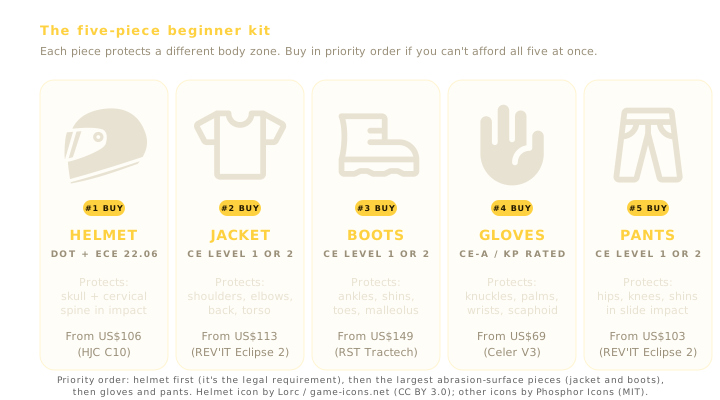
A complete head-to-toe motorcycle gear kit — helmet + jacket + gloves + pants + boots, all CE-rated, all from brand-name manufacturers — fits under US$1,000 in 2026. The recommended kit at the sweet spot is US$891 (AGV K3 helmet + Alpinestars Andes V4 Drystar jacket and pants + REV'IT Cayenne 2 gloves + Alpinestars SMX-6 V3 boots). A trimmed budget kit is US$540; a stretched version with Shoei RF-1400 + premium textile is US$1,223. Every piece carries proper safety certification — the trade-offs between tiers are comfort, weight, weather versatility, and Snell/FIM secondary certs, not raw safety.
Read the beginner kit guide for: the 5-piece priority order (helmet → jacket → boots → gloves → pants), three full kits at three price points with live cross-retailer pricing on every item, the 14-zone CE armor map (which gear protects which body part), the 5-step buying sequence if you can't afford the whole kit at once, and the gear categories beginners shouldn't waste money on yet (airbag vests, US$1k+ helmets, race leathers). 12 min read.
Step 6: Add an intercom (if you ride with a group)
Once your base safety kit is complete, the natural next addition is a Bluetooth intercom — useful for group rides, music streaming, GPS audio, and phone calls. The brand decision is locked in by network effect: Cardo's DMC mesh and Sena's Mesh 3.0 don't talk to each other. If your group rides Cardo, get Cardo; if they ride Sena, get Sena. Cardo's 2026 flagship is the Packtalk Pro (US$459); Sena's just-released 60S Evo with Bose audio (May 2026) tops their lineup. For solo riders pairing only with one partner, Midland's BTX2 Pro S (US$182) is the Bluetooth-only budget alternative.
Read the Cardo vs Sena 2026 guide for: both brands' full 2026 lineups with live catalog pricing, the DMC vs Mesh 3.0 technical comparison, the Mesh 3.0 vs Mesh 2.0 backward-compatibility trap inside Sena's own ecosystem, real-world range (~0.5–0.75 mi rider-to-rider, not the marketed 1 mi), and the per-buddy-network recommendation. 11 min read.
Step 7: Step up to adventure / dual-sport gear (if your riding has shifted)
Once you outgrow the beginner kit and your riding starts pushing into multi-day touring, off-road sections, or all-weather long-haul use, the next gear conversation is dedicated adventure / dual-sport gear. The philosophy is structurally different from street gear: textile-first (more abrasion-resistant than leather in wet conditions, far more breathable), layered (base + mid + outer shell + rain liner, separable so you adapt to weather changes mid-ride), and all-weather (built around the assumption you'll encounter 95°F desert flats and 35°F mountain passes on the same ride). Premium ADV jackets like the Klim Badlands Pro A3 (US$1,000+ catalog low, US$1,499 MSRP, CE AAA Gore-Tex Pro) cost 3× a beginner-tier jacket but last 8-12 years instead of 3-5, and cover conditions street gear physically can't.
Read the adventure & dual-sport gear guide for: the four-layer system explained, premium / mid / entry ADV jacket comparison tables (Klim Badlands Pro A3, REV'IT Defender, Alpinestars Halo, Mosko Moto Boundary IR), the Aerostich Roadcrafter R-3 phenomenon (US$1,967, made in Duluth MN), ADV-specific boots and peak-style helmets, the two-pair glove pattern (summer + winter), the cold-weather heated-electrics math with alternator-capacity warnings, and the 90-day all-weather gear test before any expedition trip. 14 min read.
Step 8: Women's-specific gear (for female riders)
Women's motorcycle gear is genuinely re-patterned at four brands — Alpinestars (Stella), Dainese (Lady), REV'IT! (Ladies), and Klim (Altitude / Artemis / Avalon) — with narrower shoulders, a shaped waist that nips in at the natural waist, and a women's last on shoes and boots (narrower heel, shorter ball-of-foot distance). At most other brands, 'women's' is a smaller size run of the unisex pattern with a different colorway. The helmet trap is different: women's helmets mostly don't exist as a separate SKU class — Shoei's own sizing documentation states all their helmets are constructed and sized identically across men's and women's product pages. The cm-of-circumference fit chart applies to female heads exactly as it does to male heads.
Read the women's motorcycle gear guide for: the four genuine-re-cut brands with category coverage, the four-check process to tell colorway from re-cut on any product page, the Dainese women's EU↔US sizing trap (EU 38 = US 0, not 28 — the gap is 38, not 10 like men's), the women's helmet myth-buster, three complete kits at three real price tiers ($674 budget / $887 recommended / $1,724 stretch), and the three women's-specific fit-test additions (chest dart sits flat, sleeve length covers wrist, boot heel locks without forward slide). 11 min read.
Step 9: Extend the riding season with cold-weather gear
When your riding pushes into the cold months — the 90-day shoulder seasons of fall and spring that extend the riding year 4 to 6 months in northern climates — the gear conversation turns to heated electrics and layering. The ecosystem has four layers (base + mid + heated + windproof outer; heat without insulation just gives you cold hot spots) and one gotcha most buyer guides skip: a full 4-piece heated kit (grips + gloves + jacket liner + pants) pulls about 180 watts, and a typical 300-400cc beginner bike has just that much available after baseline electrical load. Get the alternator math wrong and the kit drains the battery on the ride home. The Aerostich Kanetsu vest (45 W) is the efficiency leader; the Gerbing 12V Heated Jacket Liner (77 W) is the popular workhorse; KOSO Apollo heated grips (39 W max) are the highest-value-per-dollar starter upgrade.
Read the cold-weather gear guide for: the base-to-outer layered system, heated grip / glove / jacket-liner / vest / pant comparisons with verified 2026 wattages, the alternator-capacity warning with a wattage budget by bike class (300W beginner / 350W mid-naked / 510W R1250GS / 650W R1300GS / 700W tourer), fuse-block + controller + voltmeter wiring guidance, and three kit budget tiers (US$405 entry / US$705 mid / US$1,144 full). 13 min read.
Where to start
If you're brand-new to motorcycling and have zero gear yet, the highest-return reading order is Step 1 → Step 2 → Step 5: figure out cert requirements, figure out your head shape, then buy your first complete kit using the beginner-kit playbook. Steps 3 and 4 (sizing + cross-border) become relevant when you actually start shopping the gear in Step 5 — you'll consult them at purchase time, not in advance. Steps 6 through 9 are specialization tracks — Step 6 (intercom) once you're riding with other people, Step 7 (ADV gear) once your riding has shifted toward adventure / dual-sport, Step 8 (women's-specific gear) for female riders before Step 5, Step 9 (cold-weather gear) once you're riding into the colder months.
If you already have some gear and are filling in gaps, jump straight to the relevant step. The most-common gap we see in buyer questions is pants — most beginners skip them and ride in jeans, which is the single highest-risk gear shortcut. The beginner-kit guide has a dedicated section on the abrasion math (EN 13595 standard: denim fails in under a second at 8 m/s; CE-rated pants survive 4–7 seconds). Step 5 covers the fix.
If you're shopping cross-border and need to verify whether the EU purchase you're considering actually saves money after duty, VAT, and FX, jump straight to Step 4. The Alpinestars Supertech R10 worked example in the EU→Canada guide is a good calibration — if your item is in a similar price tier (≈ CAD 1,000+ retail), the math is likely to favor EU; if it's under CAD 400, domestic usually wins.
Common questions about the cluster
Do I need to read all nine guides before buying any gear?
I already have a helmet — can I skip Steps 1 and 2?
What's the most-skipped gear category that I shouldn't skip?
Why is there a separate guide for cross-border buying instead of one combined guide?
Are the prices in your guides current?
Do you cover used gear?
What ALLR does about it
Every recommendation across the nine guides links to a live ALLR product page with cross-retailer pricing for your country. The 'lowest US price' or 'cheapest in Canada' numbers in the prose are pulled from our catalog and update twice daily as our scrapers re-pull retailer inventories. Click through any link to see all the retailers carrying that exact product, sorted by landed cost (sticker price + duty + VAT-strip + shipping + currency conversion) for your buyer country.
Motorcycle gear is one of the few large categories where cross-retailer pricing isn't surfaced anywhere — the same Alpinestars Andes V4 Drystar jacket sells for US$205 at one retailer and US$280 at another. We at ALLR exist to make the price difference visible so buyers don't pay the premium for not knowing where to look. Use the nine guides as your editorial map, then let the per-product pages do the price comparison work.