Adventure motorcycle gear, decoded
Adventure and dual-sport motorcycle gear is built around a different philosophy than street: textile-first instead of leather, layered instead of single-shell, all-weather instead of fair-weather. Here's the full ADV ecosystem in 2026 — premium Gore-Tex Pro jackets, mid-tier 3-layer textile shells, the four-layer system, ADV-specific boots, helmets with peaks, and the cold-weather heated-electrics alternator-capacity gotcha most riders miss.

Adventure and dual-sport motorcycle gear works on a different premise than street or sport gear. The goal is to ride 6 to 12 hours in any conditions — desert heat, mountain cold, monsoon rain, the same kit across all of it — so the philosophy is textile-first (more abrasion-resistant than leather in wet conditions, vastly more breathable), layered (base layer + mid layer + outer shell + rain liner, separable so the rider adapts without changing kits), and all-weather (built around the assumption that the weather will change mid-ride). The result is gear that costs more up front than equivalent street gear — a premium ADV jacket runs US$800 to US$1,500 vs the US$300-500 street sport-touring equivalent — but lasts 8 to 12 years instead of 3 to 5, and covers conditions the street kit physically cannot. This article maps the complete ADV ecosystem in 2026: premium and mid-tier jackets, the four-layer system, ADV-specific boots, peak-equipped ADV helmets, two-pair glove logic, the cold-weather heated-electrics alternator-capacity gotcha, and the gear categories where buying once and crying once is the cheapest long-run path.
Why adventure gear is different from street gear
Street and sport gear is built for a narrow operating envelope: fair-weather rides at moderate-to-high speeds where abrasion in a slide is the dominant risk and weather rarely changes mid-ride. The default material is leather (race suits, sport-touring jackets), the default structure is a single shell with armor inserts, and the default weatherproofing is either none (race) or a single optional waterproof membrane (touring). The trade-off accepted is that a leather sport-touring jacket cooks the rider in summer traffic, soaks through in sustained rain, and offers no insulated layer for cold mornings — and that's fine for a fair-weather 2-hour Sunday ride.
Adventure gear discards that envelope entirely. The job description is: a single kit that handles 95°F desert flats, 35°F mountain passes, all-day monsoon rain, dust-and-rocks gravel sections, and 6-to-12-hour saddle stints on the same ride — often the same week, sometimes the same day. The structural answer is layering borrowed from outdoor mountaineering. The material answer is high-denier textile (500D to 1000D Cordura, Superfabric reinforcements in slide zones) with a separable Gore-Tex membrane. The architectural answer is vents that open wide enough to flow proper air in summer plus thermal liners that snap in for winter — the same garment, configured differently. ADV-specific brands (Klim, REV'IT!, Mosko Moto, Touratech) live in this niche; mainstream brands (Alpinestars, Dainese) build dedicated ADV lines (Halo, Bogota, Andes / Antartica, Desert) alongside their street lineups.
The cost of getting this wrong. A street sport-touring jacket worn for ADV-style riding — say a 3-day trip from a coastal start at 70°F into a mountain pass at 40°F with rain — fails on every dimension: too hot in traffic, too cold at altitude, soaked through within an hour of rain (and stays soaked because leather absorbs water), no separable rain shell to swap on at a stop. Conversely, a Klim Badlands Pro A3 worn for sport-style hot-weather commuting is heavy, noisier than purpose-built sport gear, and overpriced for what's being asked. The two philosophies don't interchange.
The four-layer system
ADV layering is the same model serious mountaineers and backpackers have used for decades, adapted to riding. From skin out: base layer (wicks sweat off the skin), mid layer (holds body heat in cold weather), outer shell (provides abrasion + impact protection), and rain liner (sheds water, either integrated into the outer shell or as a separate overshell). Each layer does one thing well, and crucially they separate — a rider can ride in just the shell on a hot day, add the rain liner when a storm hits, swap in the mid layer at altitude, and pull on the base layer for a sub-freezing dawn departure. Three respected ADV gear primers (Adventure Spec, Adventure Bike Rider, ViaTerra Gear) all converge on this four-layer model.
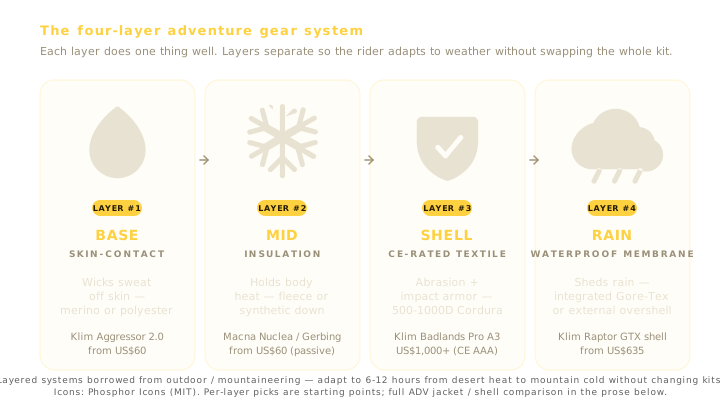
The right way to think about ADV jacket shopping is not 'which jacket do I buy' but 'which combination of layers do I need.' A premium ADV jacket like the Klim Badlands Pro A3 has the rain liner laminated directly into the shell as a 3-layer Gore-Tex Pro construction — layers 3 and 4 are integrated, you add layers 1 and 2 separately. A mid-tier jacket like the Alpinestars AMT-8 Stretch Drystar XF keeps the rain liner detachable — wear the shell in heat, snap in the liner when it rains, snap it out when the rain stops. An entry jacket like the Alpinestars Andes V4 Drystar has the same separable-liner architecture but in a less-premium fabric.
Premium ADV jackets (US$800 and up)
The premium tier is built around 3-layer laminated Gore-Tex Pro (or equivalent waterproof membrane bonded directly to the shell) plus CE AA or CE AAA abrasion rating per EN 17092-2. The lamination is the structural difference — laminated 3-layer shells are lighter, more breathable, and pack smaller than the equivalent shell + separate Gore-Tex liner. The trade-off is they're not configurable for hot weather the way a detachable-liner jacket is. At this tier, riders typically own both a premium ADV jacket for cold/wet conditions and a mesh / vented summer shell for hot conditions, alternating by season.
| Jacket | Construction | CE / armor | Lowest US |
|---|---|---|---|
| Klim Badlands Pro A3 | 3-layer Gore-Tex Pro, 1000D Cordura, Superfabric/Vectran reinforcements | CE AAA per EN 17092-2; D3O L2 + Klim Rogue EXP L2 | US$1,000 |
| Klim Badlands Pro (prev. gen) | 3-layer Gore-Tex Pro shell, predecessor to A3 — still sold at most retailers | CE AA; D3O L1+L2 mix | US$762 |
| Klim Kodiak | 3-layer Gore-Tex Pro laminated, premium touring-oriented ADV | CE AAA; D3O L2 | US$891 |
| Alpinestars Halo Pro Drystar XF | Laminated Drystar XF (3-layer), reinforced abrasion panels | CE AAA; Nucleon Flex Pro L2 shoulders + elbows | US$800 |
| Alpinestars AMT-10R Drystar XF | Laminated Drystar XF, race-cut ADV with stretch panels | CE AA; Nucleon L2 | US$535 |
| REV'IT Defender 3 GTX (jacket OOS) | Gore-Tex 2-layer, expedition-grade ADV touring | CE AA; SEEFLEX L2 | Pant: US$588 (jacket OOS) |
| REV'IT Poseidon 3 GTX | Gore-Tex 2-layer laminated, top-tier touring ADV | CE AA; SEEFLEX L2 | Pant: US$658 (jacket OOS) |
| Mosko Moto Boundary IR | Premium ADV touring, CE AA-rated, North American specialist | CE AA abrasion; CE L2 RHEON impact | US$1,199 (Mosko direct) |
Why the Klim Badlands Pro A3 is the cluster's premium default. Updated in 2024 from the long-running Badlands Pro line, the A3 is — per Klim's own spec sheet and the May-2024 ADVrider re-design coverage — the first ever Gore-Tex all-weather motorcycle garment to earn a CE AAA rating per EN 17092-2. Construction is 1000D Cordura main shell with Superfabric and Vectran reinforcements in slide-prone areas, plus 3-layer Gore-Tex Pro lamination throughout. Armor is the new Klim Rogue EXP Level 2 paired with D3O Level 2 at shoulders, elbows, and back. MSRP is US$1,499; the catalog low we see is US$1,000 at one of the import retailers we track, occasionally less on discontinued colorways. This is the jacket every other premium ADV jacket gets compared to.
The Mosko Moto question. Mosko Moto is a Pacific Northwest ADV specialist that builds CE AA-rated jackets aimed at long-distance, travel-focused trips. The Boundary IR (US$1,199) is their premier ADV touring jacket; the Basilisk IR (US$849, covered in the mid-tier table below) is their lighter enduro-touring kit. We don't currently track Mosko Moto in our catalog (they sell direct-to-consumer plus a thin dealer network); the prices linked are from Mosko's own product pages and reflect their stable MSRP.
The Klim model-name maze. Klim's premium-ADV naming is genuinely confusing: the Badlands Pro (US$762 catalog) is the previous-generation jacket, the Badlands Pro A3 (US$1,000+ catalog, US$1,499 MSRP) is the 2024 redesign, the Kodiak (US$891 catalog) is the touring-leaning premium ADV in a different cut. All three use 3-layer Gore-Tex Pro laminated shells; differences are in cut, vent layout, armor specifics, and how aggressively the abrasion reinforcements are placed. The A3 is the safest single pick if you want the latest construction; the original Badlands Pro is the cost-saver if you're OK with the previous generation (still sold at most retailers); the Kodiak is the choice for riders who want premium ADV materials in a more upright touring cut.
Mid-tier ADV jackets (US$250 to US$600)
The mid-tier is where most ADV riders actually buy. The structural difference from premium is the detachable rain liner instead of a laminated 3-layer membrane — the shell is lighter, more configurable for hot weather, and the liner snaps in or out as conditions change. CE armor is typically Level 1 or Level 2 at shoulders + elbows, with a back-protector pocket (back protector usually sold separately). Fabric is 500-600D Cordura or equivalent, less aggressive than premium-tier 1000D + Superfabric but still real protection in a slide. Most riders' first dedicated ADV jacket lands here.
| Jacket | Construction | CE / armor | Lowest US |
|---|---|---|---|
| Klim Latitude | 3-layer Gore-Tex shell, lighter weight than Badlands | CE A; D3O L1 shoulders+elbows | US$571 |
| Klim Carlsbad | Gore-Tex 2-layer, all-season touring-leaning ADV | CE A; D3O L1 | US$520 |
| Alpinestars Halo Drystar | Drystar membrane, asymmetric front zipper for airflow | CE A; Nucleon Flex Plus L1 | US$282 |
| Alpinestars Bogota Pro Drystar | Drystar membrane, touring-grade ADV with thermal liner | CE A; Nucleon Flex Plus L1 | US$287 |
| Alpinestars AMT-8 Stretch Drystar XF | Stretch shell + detachable Drystar XF liner-as-jacket | CE A; Nucleon L1 | US$406 |
| REV'IT Tornado 4 H2O | H2O membrane, 600D Polyester with reinforced abrasion zones | CE A; SEEFLEX L1 | US$340 |
| REV'IT Sand 5 H2O | 600D Nylon/ripstop shell, detachable Hydratex 3L + thermal liners | CE A; SEEFLEX L2 | US$530 (RevZilla — not yet in ALLR catalog) |
| Mosko Moto Basilisk IR | Waterproof enduro-touring, packable, YKK Aquaguard zippers | CE A abrasion; CE L2 RHEON impact | US$849 (Mosko direct) |
Why the Klim Latitude is the cluster's mid-tier default. The Latitude is Klim's mid-range ADV jacket — same Gore-Tex 3-layer shell as the Badlands Pro but in a less-armored, lighter, less-expensive construction. CE A abrasion rating (one tier below the Badlands' AAA), D3O L1 armor (vs L2), 500D Cordura instead of 1000D, lighter total weight. For riders doing primarily street + occasional fire-road ADV instead of expedition-grade off-road, the Latitude covers the use case at roughly half the Badlands' price. Same warranty, same Gore-Tex membrane, same Klim build quality.
The REV'IT Sand 5 H2O note. The Sand 5 H2O (launched August 2025, reviewed in Rider Magazine and ADV Pulse) is REV'IT's most recent ADV jacket update — successor to the long-running Sand 4. Hydratex 3L waterproof + thermal detachable liners, SEEFLEX CE L2 armor (a step up from the Sand 4's L1), 600D Nylon shell with 600D ripstop in critical zones, optional chest + back protector upgrades. MSRP US$529.99. It's not yet in our catalog — REV'IT's full Sand 5 inventory shows up in the scraper but the SKUs haven't merged to a product page yet. We track this on our 90-day re-verify cadence and will swap the RevZilla external link to a /product/ slug once it appears.
The detachable-liner trick most buyers miss. The Alpinestars AMT-8's removable Drystar XF liner is also a standalone jacket — you can ride in just the inner liner on warm rainy days when the outer shell would be overkill. Klim and REV'IT don't ship their liners this way (their liners are obviously a liner). REV'IT's Sand 5 H2O takes this further — both liners (Hydratex waterproof and thermal) can be worn separately as destination garments off the bike. If you ride to a destination and want to walk around in something normal-looking, the Sand 5's thermal liner doubles as a fleece jacket and the Hydratex liner as a packable rain shell.
Entry ADV jackets (US$150 to US$250)
The entry tier is where most riders' first ADV exposure happens — they buy a 'beginner ADV jacket' that's marketed as 'all weather' and is in fact a competently waterproof textile shell with basic CE-Level 1 armor. The trade-off vs the mid-tier is fabric weight (300-500D instead of 500-1000D Cordura, less abrasion-survival time in a slide), less-aggressive armor (one rating tier down), shorter expected lifespan (4-6 years instead of 8-12), and crucially fewer vents — entry jackets tend to be either fully waterproof shells (great in rain, hot in summer) or mesh shells (great in summer, soaked in rain), not both.
| Jacket | Construction | CE / armor | Lowest US |
|---|---|---|---|
| Alpinestars Andes V4 Drystar | Drystar membrane, polyester shell, all-weather entry ADV | CE A; Nucleon Flex L1 shoulders + elbows | US$219 |
| Klim Marrakesh | Lightweight mesh-leaning shell for hot-weather ADV | CE A; D3O L1 | US$420 |
| Klim Dakar | Off-road enduro shell, vented, hot-weather focused | CE A; D3O L1 | US$72 (closeout-priced) |
| Klim Outrider | Commuter ADV pant (jacket not in catalog), CE Level 1 hip+knee | CE A; D3O L1 | Pant: US$180 |
| Dainese Desert Tex | Polyester ADV shell with mesh ventilation zones | CE A; Dainese Pro-Armor | US$269 |
| REV'IT Tornado 3 (women's) | H2O membrane, 600D Polyester — women's-specific entry ADV | CE A; SEEFLEX L1 | US$251 |
Where the entry tier shines and where it doesn't. The Alpinestars Andes V4 Drystar is the cluster's first-ADV-jacket recommendation — covered in detail in the beginner gear kit guide and the entire focus of that article's recommended kit. It does the ADV philosophy well at US$219: textile-first, waterproof membrane, CE armor, separable thermal liner included. What it doesn't do is survive a high-speed slide as long as the Badlands Pro (less Cordura denier), insulate as warmly at altitude (the included thermal liner is thinner), or feel as plush in the cuts and lining (Drystar at the entry tier vs Gore-Tex Pro at the premium tier is a real materials difference). For street commute + occasional fire-road, that's all fine. For 3-week expedition rides across multiple climates, riders typically end up wanting the mid-tier Latitude or premium Badlands within 2-3 seasons.
The Klim Dakar caveat. The Klim Dakar shows at US$72 in our catalog — that's a closeout/clearance price, not the typical Dakar US$300-400 MSRP. Klim's Dakar line is genuinely good off-road ADV gear (vented mesh shell, CE armor, hot-weather focus), but the catalog low you see today is unlikely to be repeatable. If you want a vented hot-weather Klim shell at MSRP, the Marrakesh (US$420 catalog) is the in-production option; the Dakar is worth grabbing at the closeout price if size and color line up.
The Aerostich Roadcrafter phenomenon
No ADV gear article is complete without the Aerostich Roadcrafter — the one-piece textile suit hand-made in Duluth, Minnesota since 1985 that has become the canonical North American touring + ADV garment for serious mileage. The current production is the R-3 one-piece suit, priced at US$1,967 as of May 2026. Construction is mil-spec 500D Cordura TLTex outer fabric (made in USA), 100% waterproof, unlined for airflow, and engineered to slip on over street clothes in about 60 seconds. The pitch is unusual: it's not the most-protective gear, it's not the most-waterproof, it's not the most-vented — it's the gear you'll actually wear because you can throw it on over a suit and tie, ride to work, and pull it off at the office without changing clothes.
The R-3 isn't in the ALLR catalog and likely never will be. Aerostich is direct-to-consumer only (sells from aerostich.com and a single retail showroom in Duluth) — no dealer network, no other retailer carries them. That means no cross-retailer pricing to compare, no landed-cost optimization, no scraper coverage. We mention them because the Roadcrafter is the gear every long-distance ADV rider in North America eventually considers, and ignoring that conversation would leave the article incomplete.
When to buy a Roadcrafter and when not to. Buy the R-3 if your use case is high-mileage commuting (the over-street-clothes pitch is genuinely useful), multi-day touring where time-to-gear-up matters (1-piece is faster than separate jacket + pants), or you specifically want made-in-USA gear. Skip it if your use case is aggressive off-road ADV (a Klim Badlands Pro A3 has better abrasion zones and armor for falling on dirt), serious cold-weather riding (the unlined-for-airflow design is less warm than a thermal-lined ADV shell), or hot-weather mesh riding (the Roadcrafter vents but doesn't approach a mesh shell's airflow). Aerostich is unapologetically a touring + commuter brand; ADV-specific brands win at off-road.
ADV boots: the ankle-protection-plus category
ADV boots are a distinct category from street sport-touring boots — taller shaft (mid-calf to knee height for most ADV boots, vs ankle-high for sport-touring), more aggressive sole pattern for off-road traction, stiffer shin protection for footpeg impacts and rock strikes, and almost always a Gore-Tex or equivalent waterproof membrane. The trade-off vs sport-touring boots is they're heavier (1.5-2.5 kg per pair vs 1 kg for SMX-6 V3-class sport boots), less comfortable to walk in off the bike, and harder to break in. The trade-off pays off the first time you step into a 6-inch puddle at a gas stop or take a hard footpeg hit on a single-track section.
| Boot | Shaft height + features | Waterproof | Lowest US |
|---|---|---|---|
| Klim Adventure GTX | Mid-calf shaft, BOA fit, Michelin WIC sole, 5mm XRD ankle armor | Gore-Tex | US$500 |
| Sidi Adventure 2 Gore-Tex | Mid-calf, replaceable instep strap, Sidi adjustable buckle system | Gore-Tex | US$228 |
| Sidi Gavia Adventure | Touring-leaning ADV, lighter than Adventure 2, Gore-Tex | Gore-Tex | US$317 |
| Alpinestars Toucan Gore-Tex | Tall shaft, race-class ankle armor + double buckle closure | Gore-Tex | US$310 |
| Alpinestars Corozal V2 Drystar | Mid-calf ADV touring, removable Drystar membrane | Drystar | US$228 |
| Forma Adventure Pro Dry | Tall shaft Italian ADV, Dryline membrane, anatomic flex zone | Dryline (Forma WP) | US$331 |
| Forma Adventure Low WP | Lower shaft (calf-height), more walkable, ADV-meets-touring | Forma WP | US$189 |
| Gaerne G-Dune Aquatech | Italian ADV with Aquatech waterproofing, mid-calf shaft | Aquatech | US$229 |
| TCX Clima 2 Surround GTX | Mid-shaft touring-ADV, GTX Surround for venting + waterproofing | Gore-Tex Surround | US$221 |
The Klim Adventure GTX premium pick. The Klim Adventure GTX boot is the cluster's recommended ADV boot at the premium tier — Gore-Tex membrane, Michelin WIC outsole (a winter-tire compound adapted for ADV — exceptional grip on wet metal and rocks), the BOA Fit System for fine shaft adjustment, 5mm thick XRD ankle armor, polycarbonate lasting board, reinforced shin and shifter plates, and Klim's lifetime warranty. MSRP US$449.99 per Klim and ADV Pulse coverage; catalog low US$499.99 at Cycle Gear or MotorcycleCloseouts. Reviews from Ride Adventures consistently report 3+ years of hard use with the waterproofing intact.
The Sidi Adventure 2 value pick. The Sidi Adventure 2 Gore-Tex is the cluster's value-tier ADV boot — half the Klim's price (US$228 catalog), proven Sidi adjustable-buckle system, replaceable instep strap (so a worn-out strap is a US$15 fix instead of a US$500 boot replacement), and the same Gore-Tex membrane. The trade-offs are slightly less ankle armor than the Klim, less-aggressive Michelin-compound sole grip, and the older Sidi shaft cut runs noticeably narrow — riders with high arches or wide calves should size up half a US size and try on if possible. Sidi historically has minor sizing offsets vs other Italian brands; see the EU vs US sizing guide for the per-brand boot conversion.
ADV gloves: the two-pair pattern
Most ADV riders own two pairs of gloves, not one — a warm-weather vented summer pair and a cold-weather insulated winter pair — because no single glove handles 95°F desert riding and 35°F mountain riding well. A summer ADV glove prioritizes airflow (mesh panels, vented knuckles), short-cuff convenience, and lightweight CE-A armor; a winter glove prioritizes Gore-Tex membrane + insulation, longer gauntlet cuff to seal against the jacket sleeve, and heavier knuckle armor. Buying both pairs upfront is the cheaper long-run path than buying one 'all-weather' compromise glove that does both jobs poorly.
| Glove | Season | Features | Lowest US |
|---|---|---|---|
| Klim Adventure GTX Short | 3-season | Gore-Tex, knuckle armor, short-cuff for grip feel | US$180 |
| Klim Badlands GTX Long | Winter / wet | Gore-Tex, gauntlet cuff, full-finger insulation | US$239 |
| Klim Badlands Aero Pro Short | Summer / hot | Ventilated mesh + leather, CE KP knuckles, short cuff | US$113 |
| Klim Marrakesh | Summer / hot | Lightweight ventilated ADV glove, CE-A rated | US$100 |
| Klim Dakar Pro | Off-road / enduro | Minimal-padding off-road glove for hot-weather trail riding | US$70 |
| Alpinestars Corozal V3 Drystar | 3-season | Drystar membrane, CE-A, gauntlet cuff | US$80 |
| Alpinestars Bogota Drystar XF | 3-season touring | Drystar XF, longer cuff, knuckle protection | US$102 |
| REV'IT Cayenne 2 | 3-season | Hydratex membrane, gauntlet, breathable mesh panels | US$141 |
| REV'IT Sand 4 H2O | Summer / wet | Hydratex H2O, mesh + leather, lightweight ADV glove | US$98 |
| Touratech Guardo Desert+ | Summer / hot | Touratech's enduro-touring summer glove, lightweight + vented | US$104 |
The recommended 2-pair starting kit. A Klim Adventure GTX Short (US$180) for 3-season use plus a Klim Marrakesh (US$100) for hot weather covers the spectrum — Gore-Tex 3-season with knuckle armor, plus a lightweight vented summer glove that still has CE-A rating. Total US$280. For sub-freezing winter rides, add a Klim Badlands GTX Long (US$239) gauntlet as a third pair — that's the 3-glove cycle most serious year-round ADV riders end up running. Cheaper alternatives that get most of the way: Alpinestars Corozal Drystar (US$80) for 3-season, Touratech Guardo Desert+ (US$104) for summer.
The wrist gauntlet matters more than buyers think. Glove gauntlets seal the wrist against the jacket sleeve — without it, cold air and rain channel up into the jacket cuff. Short-cuff gloves are quicker on/off and offer better bar-control feel, but in cold or wet weather the gauntlet earns its weight back inside the first hour. Pair short-cuff gloves with short-cuff jackets (sport / urban / vented summer ADV) and gauntlet gloves with long-cuff ADV touring jackets. The Klim Badlands Pro A3 jacket cuff is specifically designed to overlap with a Klim Badlands GTX Long gauntlet — the rest of the kit is engineered around the seal.
ADV helmets: the peak-style category
ADV helmets are visually distinct from street full-face helmets by the peak (visor) at the top of the shell — a small aerodynamic shade originally designed for off-road sun-blocking that's become the iconic visual signature of ADV-style riding. The peak is functional (sun-blocking in dirt-mode where the rider often wears goggles instead of a face shield), but it also adds drag and lift at highway speeds — most modern ADV helmets have removable peaks so riders can run the helmet in 'street mode' on long highway sections and put the peak back on for off-road. ADV helmets typically also have a face shield (street mode), accept goggles (dirt mode), have aggressive chin-bar venting, and weigh slightly more than equivalent-tier street full-faces because of the dual-shield-plus-peak hardware.
Cert standards apply the same way as street helmets — DOT + ECE 22.06 minimum, with optional Snell M2025 (added rotational testing in late 2023, see the helmet certifications guide) and FIM FRHPhe-02 (racing-only) at the premium tier. ECE 22.06's oblique-impact requirement maps directly to ADV use cases where the rider is more likely to take a low-side dirt impact than a high-speed asphalt slide.
| Helmet | Construction | Certification | Lowest US |
|---|---|---|---|
| Klim Krios Pro | Hand-laid carbon fiber, Koroyd impact-absorbing core, 1300g (M) | DOT + ECE 22.06 | US$600 |
| Klim TK1200 Modular | ADV modular (chin bar lifts) — premium long-haul ADV helmet | DOT + ECE 22.06 | US$686 |
| Arai Tour-X5 / XD-5 | Arai's current ADV helmet (Tour-X5 in EU/UK = XD-5 in North America); successor to the XD-4; hand-built intermediate-oval shell | DOT + ECE 22.06 | US$596 |
| Shoei Hornet ADV | Shoei's mainstream ADV helmet, intermediate-oval, removable peak | DOT + ECE 22.06 | US$344 |
| Shoei Hornet X2 Dual Sport | Premium Shoei ADV, AIM+ multi-fiber shell, refined ventilation | DOT + ECE 22.06; Snell-class shell | US$700 |
| Klim Marrakesh Helmet | Mid-tier Klim ADV helmet — matches the Marrakesh jacket line | DOT + ECE 22.06 | US$380 |
| Touratech Aventuro PRO Carbon+ | X-PRO carbon shell, integrated sun visor, 8 intake + 4 exhaust vents | DOT + ECE 22.06 | €699 / ~US$755 (Touratech direct — not in ALLR catalog) |
Why the Klim Krios Pro is the cluster's ADV helmet default. Per Klim's spec sheet, the Krios Pro uses hand-laid carbon fiber shell construction with Koroyd impact-absorbing core (the same crushable-tube structure used in MIPS-compatible bicycle helmets), DOT + ECE 22.06 certification, Pinlock-ready polycarbonate shield with Transitions photochromic lens included in the box, and a 4-mode ventilation system (street / adventure / dirt / trail) with adjustable chin and forehead vents. MSRP US$749.99. The Krios Pro fits the same intermediate-oval head shape Klim describes for the rest of their helmet line (co-developed with 6D, whose internal shape is intermediate) — see the helmet head shapes guide for which brand fits which skull.
The Arai ADV naming maze, explained. Arai's ADV helmet sells under two different names in two different markets: it's the Tour-X5 in Europe and the UK and the XD-5 in North America — same shell, same internal padding, same Arai hand-built construction, different sticker. Both names refer to the same current-production ADV helmet, which is the successor to the long-running XD-4 (Tour-X4 in Europe). Most ALLR retailer scrapers pick up the European 'Tour-X5' naming because the listings we track are predominantly EU-import inventory; the linked product page resolves to the same Arai helmet a US buyer would call the XD-5. Don't confuse the XD-5 with Arai's Contour-X — that's an entirely different helmet, a street full-face that sits in Arai's intermediate-oval road line (Regent-X / Contour-X / Corsair-X) with no peak and no ADV use case.
The Touratech Aventuro callout. Touratech's 2026 helmet lineup has three models: the Aventuro Travel Carbon Graphite (entry composite), Aventuro Matrix PRO (€459, new X-MATRIX2 multi-composite shell with integrated sun visor), and Aventuro PRO Carbon+ (€699, top X-PRO carbon shell with integrated sun visor — adds the visor that the original Aventuro Carbon Pro lacked). DOT + ECE 22.06 certified. Touratech sells primarily through their direct US site at touratech-usa.com plus a thin dealer network; the helmets aren't in the ALLR catalog. Worth knowing about because Touratech is the de facto ADV accessories brand for BMW R 1300 GS riders, and many GS buyers default-buy the matching Aventuro helmet for visual consistency.
Cold-weather electrics: the short version
ADV riding into sub-freezing temperatures pushes textile layers past their passive-insulation limit, and the fix is powered heating — heated grips, a heated jacket liner, and heated glove liners. But the gotcha that decides whether your bike can actually run a full heated kit is alternator capacity, not the gear: a full kit pulls more watts than a small-displacement bike has spare after its own electrical load, and the bike-by-bike math is where most riders get caught. We cover the complete heated-gear ecosystem — grips, gloves, jacket liners, vests, pants — and the wattage budget by bike class in the dedicated cold-weather motorcycle gear guide, which is the canonical home for that math (heated-gear product picks, the layered base-to-outer system, and which bike classes have the alternator headroom and which don't).
Buy once, cry once: the ADV-gear depreciation arc
Premium ADV gear isn't priced the way street gear is. The Klim Badlands Pro A3 at US$1,499 MSRP looks like a luxury markup until you map out the lifespan and total-cost-of-ownership math. Premium ADV gear is engineered for 8 to 12 years of hard use before the waterproofing membrane delaminates (Gore-Tex Pro lifespan), the abrasion zones thin enough to need re-sleeving (Cordura wear), or the armor inserts compress past spec (D3O degradation). Mid-tier ADV gear lasts 5-8 years; entry-tier 3-5 years. A Klim Badlands Pro A3 at US$1,499 amortized over 10 years is US$150/year; an entry-tier US$300 ADV jacket replaced every 4 years is US$75/year. The premium gear is twice as expensive per year — but it's also CE AAA-rated instead of CE A, lighter, more breathable, more waterproof, more comfortable, and noticeably better in conditions that would defeat the entry jacket.
The right way to budget premium ADV gear is to think of the full kit (jacket + pants + boots + helmet + 2 gloves) as a US$3,500-5,000 outlay that lasts a decade rather than a series of US$300-800 line items that each get replaced every 3-5 years. The math favors the premium kit if you ride 5,000+ km/year in ADV conditions; it favors the mid-tier kit if you ride 2,000-5,000 km/year; it favors the entry-tier kit if you ride less than 2,000 km/year (because you'll outgrow the gear's use case before it wears out).
Resale value is the second-order effect. Premium ADV gear holds value on the used market — a 3-year-old Klim Badlands Pro in good shape sells for 60-70% of new MSRP on ADVrider classifieds. A 3-year-old entry-tier ADV jacket from a smaller brand sells for 20-30% if it sells at all. Total cost of ownership over 10 years, factoring in resale at year 5 if you decide to upgrade, favors the premium gear by an even wider margin than the up-front comparison suggests. This is why the ADV community's collective wisdom is 'buy the gear you actually want' rather than 'start with budget and upgrade later' — the depreciation curve makes budget gear genuinely more expensive over time.
The 90-day all-weather ADV gear test
Before any expedition-length ride, ADV-specific gear should be tested across the conditions the trip will actually encounter. New gear that fits perfectly in the store can fail at hour 4 of a 6-hour ride in the rain. The 90-day all-weather test below is what most ADV instructors recommend before committing to a multi-day trip with new gear — it surfaces fit problems, ventilation problems, and waterproofing problems with time to return or exchange.
- 01Hot-weather all-vents-open ride (90°F+ ambient).Wear the full kit for 2+ hours in the hottest conditions you'll encounter. All vents open, all liners removed. The jacket should flow enough air that you don't reach the dangerous-overheating-while-stopped-at-lights state in city traffic. If you're overheating, the kit is wrong for the trip's hot end — swap the outer shell for a more-vented option (Klim Marrakesh, Alpinestars Halo Drystar) or accept that you'll need to do an early-morning departure to avoid mid-day heat.
- 02Rain ride (real rain, not sprinkler).Ride in actual rain for 1+ hour. The waterproof membrane should keep you fully dry at neck, wrists, ankles. Check the inside of the jacket for water tracking up the cuffs (gloves not sealing) or down the neck (collar gap). If water gets in, the gauntlet-to-cuff seal or the collar fit is wrong. Most ADV gear fails this test first at the cuff seal — adjust glove gauntlet position or add a wrist gaiter.
- 03Cold-weather full-layer ride (40°F or below).Add the thermal mid-layer and base layer. Ride 2+ hours. The kit should be warm enough at highway speed without heated electrics, with electrics it should be warm enough for sub-freezing temperatures. If you're cold without electrics in 40°F conditions, the mid-layer is too thin — upgrade to a Gerbing-style fleece liner or a Macna heated jacket. If electrics are needed at 40°F, plan for them to run continuously at altitude.
- 04Long-day endurance ride (6+ hours).Multi-hour saddle time surfaces pressure points the in-store fit doesn't. Helmet brow / temple / crown pressure (see the helmet head shapes guide), boot ankle / shin / arch pressure, jacket collar / shoulder / wrist pressure. Anything that's uncomfortable at hour 4 will be agony at hour 10. Fix or exchange before the trip; never plan to 'break in' premium gear during the trip itself.
- 05Off-bike walkability test.ADV trips involve gas stops, hotel check-ins, restaurant visits in full kit. Walk 500m in the boots loaded with whatever sock layer you'll wear riding. ADV boots are notoriously stiff off the bike — that's by design (ankle protection requires a stiff shaft) — but if the sole flexion is unworkable for short walks, you'll be miserable at every gas stop. Forma's Adventure Low WP and Sidi's Gavia Adventure are the most walkable mid-tier ADV boots; tall-shaft enduro boots (Sidi Crossfire 3, Alpinestars Toucan) are barely walkable and are pure on-bike gear.
- 06Pack-down test (multi-day trip simulation).Pack the gear into the panniers / soft luggage you'll actually use. Premium 3-layer laminated jackets are noticeably bulkier than mid-tier detachable-liner jackets (because the rain liner can't separate to be packed flat). If the kit doesn't pack into the available luggage, you'll either be wearing layers you don't need or leaving layers at home you do need. Adjust luggage choice or layer strategy before the trip, not at the trailhead.
Common questions
What's the actual difference between ADV gear and street touring gear?
Why is the Klim Badlands Pro A3 so expensive?
Do I need separate ADV boots or can I use sport-touring boots?
Why are ADV helmets shaped differently from street full-face helmets?
What's the deal with the Aerostich Roadcrafter — is it worth US$1,967?
How does the cold-weather alternator-capacity warning actually work?
Can I just buy one good ADV jacket and skip the layered system?
What's the difference between Drystar, H2O, Hydratex, Aquatech, and Gore-Tex?
What ALLR does about it
Every product linked in this article has a live ALLR product page with cross-retailer pricing for your country — duty, VAT-strip, shipping, and currency conversion factored into the landed price you see. Prices update twice daily as our scrapers re-pull retailer inventories. ADV gear in particular has wide cross-retailer price spreads — the same Klim Badlands Pro A3 sells for US$1,000 at one retailer and US$1,499 at another, the same Sidi Adventure 2 Gore-Tex sells for US$228 at one and US$340 at another. Click through any link to see all retailers carrying that exact product, sorted by landed cost for your buyer country.
Two gaps worth flagging. First, Aerostich (Roadcrafter R-3), Mosko Moto (Boundary IR, Basilisk IR), and Touratech (Aventuro helmets) sell primarily direct-to-consumer with thin or non-existent dealer networks — we don't track their pricing in our catalog and the external links in this article go to the manufacturer's own product page. The pricing for those items reflects the brand's stable MSRP; cross-retailer comparison isn't available for them. Second, the REV'IT Sand 5 H2O (US$529.99 MSRP) is too new to be in our catalog yet — the SKUs appear in REV'IT's catalog feed but haven't merged to a product page on ALLR. We'll swap the external RevZilla link to a /product/ slug on the next 90-day re-verify pass.
Adventure gear is one of the gear categories where ALLR's cross-retailer comparison earns its keep most clearly — premium ADV jackets in the US$800-1,500 range have the widest price spreads of any motorcycle gear category we track, and even mid-tier ADV gear in the US$300-600 range routinely shows US$100+ spreads across retailers carrying the same SKU. We at ALLR exist to make those spreads visible so ADV buyers don't pay the premium for not knowing which retailer has the best landed price for their country. Use the tables in this article as a starting map; find the size, color, and retailer combo that fits your budget on the linked product pages.
This guide is part of the motorcycle gear buying playbook — the hub is the canonical sequence across all topic-deep guides.