Cold-weather motorcycle gear, decoded
Cold-weather motorcycle gear extends the riding season 4-6 months in northern climates — but only if the layered system works as a whole. We at ALLR explain the base-to-outer layering philosophy, compare every heated gear category (grips, gloves, jacket liners, vests, pants), and lay out the alternator-capacity math most buyer guides skip: a full 4-piece heated kit (grips + gloves + jacket liner + pants) pulls about 180 watts combined, and a typical 300-400cc beginner bike has just that much available after baseline electrical load. Get the math wrong and the gear drains the battery on the way home.

Cold-weather motorcycle gear extends the riding season 4 to 6 months in northern climates — a 90-day fall + 90-day spring window that lives or dies on the gear. But the heated-gear category is also the place new riders get the math wrong most often. A full 4-piece heated kit (grips + gloves + jacket liner + pants) pulls about 180 watts combined, and a typical 300-400cc beginner bike has exactly that much available after baseline electrical load. (A trimmer 3-piece kit — grips + gloves + jacket liner, no pants — lands closer to 130 W; we use the 4-piece basket as the cluster-wide reference number so the numbers reconcile across guides.) We at ALLR built this guide to cover the full cold-weather ecosystem — base layers, mid-layers, heat, accessories — with the wattage math made explicit, the product picks verified against our catalog, and every claim sourced.
Layered system: base → mid → heat → windproof outer
Heated gear is not a replacement for insulation — it's an addition. Riders who skip the base + mid layers and just buy heated grips + heated jacket liner get cold hot spots: the heating elements feel warm right where the wires sit, but the body still bleeds heat everywhere else. The correct stack is four layers deep.
- 01Base layer (next to skin).Moisture-wicking technical fabric (polyester / spandex blend or merino wool). Pulls sweat off the skin so it doesn't evaporate against you in a 65-mph windblast. Without a proper base layer, heated gear works against you — the heating element warms the wet shirt, the wet shirt cools as wind hits it, and you end the ride colder than you started. Klim Aggressor, REV'IT Thermic, Smartwool 250 are the canonical picks.
- 02Mid layer (insulation).Fleece or down. Traps air against the body without compressing under the riding jacket. Fleece (Klim Inferno, Polartec) is the moto-friendly choice because it doesn't lose insulating value when slightly damp. Down packs warmer per gram but loses everything when wet — wrong choice when you're inside a Drystar shell.
- 03Heat layer (heated jacket liner or vest).Goes between the mid layer and the outer riding jacket. Heating elements warm the air trapped by the insulation layers — that's why mid-layer insulation matters. Without insulation, the heat radiates away as soon as it leaves the heating element.
- 04Windproof outer (riding jacket).Standard riding jacket with abrasion-resistant shell and CE-rated armor. The waterproof membrane (Gore-Tex, Drystar) doubles as a windproof barrier that prevents the heated mid-layer's warmed air from blowing away. The beginner gear kit guide covers the riding-jacket layer — same picks apply in winter.
Base layers: the foundation most riders skip
A base layer for motorcycle use needs three properties a generic thermal does not: longer sleeves (so wrists don't expose when you reach for the bars), longer torso (so kidneys stay covered in the riding crouch), and flatlock seams (so shoulder seams don't grind against the inside of the jacket on a long highway run). Klim, REV'IT, and Alpinestars all build moto-specific cuts; Smartwool and Icebreaker do not but work fine if you size up a length.
| Pick | Weight | Use case | Lowest US price |
|---|---|---|---|
| Klim Aggressor -1.0 Short Sleeve | lightweight | Cool morning starts, late spring / early fall | US$67 (Motocard) |
| Klim Aggressor 1.0 Long Sleeve | 170 g, 84% poly / 16% spandex | Daily moderate cold (40-55°F) | US$120 (FortNine) |
| Klim Aggressor Pant 2.0 | mid-weight | Below 40°F, paired with riding pants | in catalog |
| Klim Aggressor Pant 3.0 | 255 g, 93% poly / 7% spandex | Below 25°F, the warmest non-heated option | in catalog |
| REV'IT Thermic base layer shirt | mid-weight | REV'IT-cut bias for narrow shoulder / long torso | in catalog (re-stocking) |
The Aggressor naming is counter-intuitive. Klim's letter-and-number scale runs from -1.0 (lightest, paradoxically named 'cool') to 3.0 (warmest). The Aggressor 3.0 long sleeve weighs 255 grams in 93% polyester / 7% spandex with a gridded heat-trapping construction; the Aggressor 1.0 is 170 grams. The temperature rule of thumb: 1.0 for moderate cold (40-55°F), 2.0 for cold (25-40°F), 3.0 for deep cold (below 25°F).
The merino wool alternative. Smartwool Merino 250 and Icebreaker 260 BodyfitZONE are both 250 g/m² merino tops that work on a bike but cost about double the Klim Aggressor for the same warmth. The trade: merino doesn't smell after a week of wear (great for tours), while synthetic dries faster and washes easier (better for commute). For pure moto use the Aggressor wins on price-per-warmth; for moto + travel + camping the merino is worth the premium.
Mid layers: fleece bridge between base and heat
The mid layer is the most-skipped piece of the cold-weather stack. Riders who skip directly from base layer to heated jacket liner find the heat dissipates instantly because there's no insulation to trap it. A fleece mid-layer doesn't add much by itself — but it transforms how much you feel the heat layer above it.
| Pick | Weight | Lowest US price |
|---|---|---|
| Klim Inferno Jacket (fleece — not heated) | lightweight insulating fleece | US$110 (Klim direct) |
| Klim Inferno Pant (fleece bottoms) | matching fleece pant | US$100 (Klim direct) |
Naming trap: Klim Inferno is fleece, not heated. The Inferno line is Klim's polyester fleece mid-layer family — it's the bridge piece designed to go between the base layer and the heated vest or jacket liner. It's the layer that gives your heated jacket liner somewhere to deposit warmth. If you want the heated Klim option, that's the Override eFire vest, not the Inferno.
Heated grips: cheapest, easiest cold-weather upgrade
Heated grips are the highest-value-per-dollar cold-weather upgrade. Fingertip warmth disappears first in cold air (the hands sit in front of the rider in clean airflow), and a $130-200 set of heated grips solves the problem completely without needing heated gloves, batteries, or wiring controllers. They also pull modest power — typically 30-48 watts at max setting — which fits any bike's alternator budget.
| Brand / model | Max draw | Heat settings | Approx. MSRP |
|---|---|---|---|
| KOSO Apollo | 2.9 A / ~39 W | 5 (20/40/60/80/100%) | US$130-145 |
| Oxford HotGrips Pro Adventure | ~3.6 A avg / 4 A max (~48 W) | 3-5 (model-dependent) | US$170-200 |
| Symtec Heat Demon | < 4 A (~48 W) | Hi/Lo or 5-level | US$60-100 |
| Macna Heated Grips (in ALLR catalog) | model-dependent | Multi-level + Bluetooth (BT variant) | tracked |
Installation difficulty matters more than wattage. Most heated grips replace the existing grips (5-10 minutes if you have a torx driver) and tap into an ignition-switched 12V circuit (another 15-30 minutes if you can find it). The KOSO Apollo and Oxford grips both include automatic low-voltage cutoff — they sense battery voltage falling below 11.5V and shut off, which means a beginner can install them without a relay or fuse block. The Symtec Heat Demon doesn't have that protection — pair it with a switched ignition source or you'll occasionally find a dead battery.
OEM heated grips. Many bikes (BMW R-series, Triumph Tiger, Yamaha Tracer, Kawasaki Versys) offer heated grips from the factory as a $200-400 option. The factory units integrate cleanly with the bike's electronics (no relay, no fuse block, controller on the dash) but typically draw slightly more than aftermarket — BMW's factory grips run about 4 A. If you're buying a new bike, take the OEM option; if you're retrofitting, the aftermarket KOSO Apollo or Oxford HotGrips Pro is the safer pick.
Heated gloves: bike-powered vs battery-powered
Heated gloves split into two ecosystems with different trade-offs. Bike-powered (12V) gloves plug into a coiled cable that runs up the sleeve to a 12V coaxial connector on a jacket liner or directly to the bike battery. They produce continuous, high-watt heat (about 22-30 W per pair) for as long as the bike runs. Battery-powered (7V) gloves carry lithium-ion packs in the cuff that produce 8-9 hours of mild heat or 1.5-3 hours of full heat. Both are real products; the choice depends on whether you commute (battery wins) or tour (bike-powered wins).
| Brand / model | Power | Notes | Lowest US price |
|---|---|---|---|
| Gerbing 12V G4 Heated Gloves | 12V bike-powered | Microwire heating, OEM-style controller required | US$160 (MotoSport) |
| Gerbing 12V Vanguard Heated Gloves | 12V bike-powered | Heavier construction for sub-freezing rides | in catalog |
| Gerbing 12V Extreme Hard Knuckle | 12V bike-powered | Adds knuckle armor for crash protection | in catalog |
| Gerbing 7V S7 Battery Heated Gloves | 7V battery (Li-ion) | Full-finger heating, 3 heat settings | US$349 (MotorcycleGear) |
| Alpinestars HT-7 Heat Tech Drystar | 12V or battery (hybrid) | Bluetooth + app control, smart auto-on | US$312 (Motocard) |
| Klim Resistor HTD Gauntlet | Battery (per-glove Li-Po) | 8 h low / 3 h med / 1.5 h high; auto-cycle on high to preserve battery | US$300 (klim.com) |
| Mobile Warming Textile Heated Gloves | 7.4 V battery | Up to 9 hours on low; the runtime leader | US$200-250 |
Pick by use case. Daily commute under 1 hour each way: battery-powered gloves. The 3-hour high-heat runtime is plenty, charging happens overnight, no wiring on the bike. Long-distance touring (200+ mile days): bike-powered gloves. Batteries die at exactly the wrong moment (1 hour into a 4-hour cold morning), and a coiled wire up the sleeve is invisible inside a gauntlet jacket. Track day in winter: doesn't matter, you'll be too warm anyway.
The Gerbing 12V vs 7V split. Gerbing is the original heated motorcycle clothing brand — founded in 1976 by Gordon Gerbing in a Washington machine shop, the first heated jacket liners were sewn in his garage from electric-blanket wire (per the company's own history). Their current line splits clearly: 12V models for riders who plan to wire to the bike (G4, Vanguard, EX Pro, Extreme Hard Knuckle); 7V models for riders who want battery-only convenience (S7, Atlas Ultra-Flex). The 12V draw runs about 22-30 W per glove pair; the 7V batteries hold roughly 14-22 Wh and last 1.5 to 8 hours depending on heat setting.
Heated jacket liners: the workhorse of the heated kit
The heated jacket liner is the single piece that turns a cold ride into a comfortable one. It goes on under the regular riding jacket, runs off the bike's 12V system, and warms the torso (where the body loses the most heat) plus the arms and the back of the neck. Most liners draw 65-90 watts at maximum heat — meaningful but manageable on most bikes. Some draw less (Aerostich Kanetsu at 45 W) using a windproof outer shell to retain more heat with less electrical output.
| Brand / model | Wattage at max | Power source | Lowest US price |
|---|---|---|---|
| Gerbing 12V EX Pro Heated Jacket (full jacket) | ~95 W (7 zones) | 12V bike-powered | US$618 (FortNine) |
| Gerbing 12V Heated Jacket Liner 2.0 | 77 W (6.4 A @ 12V) | 12V bike-powered | US$280 (gerbing.com) |
| FirstGear Gen 4 Heated Liner | ~75 W | 12V bike-powered | US$225 (MotoSport) |
| Aerostich Kanetsu Airvantage | 45 W (3.3 A) | 12V bike-powered + air bladder | US$247 (aerostich.com) |
| Warm & Safe Generation 90 W Liner | 90 W nominal (~106 W @ 13.8 V) | 12V bike-powered | US$320 (warmnsafe.com) |
| Warm & Safe Generation 65 W Liner | 65 W nominal (~85 W @ 13.8 V) | 12V bike-powered | US$260 (warmnsafe.com) |
The Aerostich Kanetsu is the efficiency leader. A 45-watt jacket liner (vs Gerbing's 77 W and Warm & Safe's 90 W) sounds like less heat — and in absolute terms it is — but Kanetsu's patented air-bladder design inflates against the body and the windproof outer, trapping the warmed air more efficiently. Per Aerostich's own measurements (and confirmed by Motorcycle.com testing), the 45-W Kanetsu feels comparable to the 77-W Gerbing in 40-50°F riding. Below freezing, the higher-wattage Gerbing pulls ahead. On a small-displacement bike with tight alternator budget, the Kanetsu's 45 W draws is the right pick.
Vest vs jacket liner. A heated vest (no sleeves) draws about 40-50 W; a full jacket liner with sleeves draws 65-95 W. Vests are popular as the entry-level heated layer — they cover the torso (where you lose the most heat) at lower wattage and pair well with non-heated gloves + heated grips. Jackets are the right pick once you've added heated gloves to the kit, because both pieces share a single 12V power connection at the bike.
Heated vests: battery-powered alternatives
If wiring to the bike isn't an option (rented bikes, modern keyless ignition, dealer-installed accessories voiding warranty), battery-powered heated vests fill the gap. The same body coverage as a 12V vest, with lithium-ion packs running 4-8 hours per charge. Range is the trade-off — bike-powered runs indefinitely while the engine runs; battery runs out exactly when you don't want it to.
- 01[Klim Override eFire Vest](/product/klim-override-vest-efire-jacket) (US$360 lowest in our catalog at MotoHut).Klim's battery-powered heated mid-layer. Two vertical heat panels on the upper chest + one horizontal panel on the upper back. USB-C charged battery (universal — no proprietary charger required). Three heat modes (low, med, high). The most polished battery vest for moto use as of 2026.
- 02[Gerbing 7V Thermite 2.0 Heated Fleece Jacket](/product/gerbing-7v-thermite-2-0-heated-fleece-jacket).Battery-powered heated fleece — doubles as a mid-layer (fleece insulation) AND a heat layer (Microwire heating elements). 7.4V Li-ion battery in a cuff pocket. Wear it under a riding jacket or as a stand-alone in the garage between rides. Tracked in our catalog.
- 03[Gerbing 7V Khione 2.0 Insulated Heated Jacket](/product/gerbing-7v-khione-insulated-heated-2-0-jacket) (US$386 lowest, FortNine).Stand-alone heated puffer jacket for use off the bike. Not a moto piece — but a piece riders buy alongside their bike-powered liner because it solves the 'arrived cold, need to walk somewhere' problem. Insulated synthetic + battery heat at the core panels.
Heated pants: the rarely-mentioned final piece
Heated pants and pant liners exist but are uncommon — most riders cover legs with non-heated insulated pants instead. The exception is long-distance touring in sub-freezing weather, where the wind chill at 65 mph drops the thigh and calf temperature faster than non-heated insulation alone can compensate. Gerbing is essentially the only major manufacturer in the category.
| Pick | Wattage | Lowest US price |
|---|---|---|
| Gerbing 12V Heated Pant Liner (bike-powered) | ~43 W (3.6 A @ 12V) | US$249 (gerbing.com) |
| Gerbing EX Pro 12V Heated Pants (bike-powered, stand-alone) | ~50 W | US$350-400 |
| Gerbing 7V Heated Base Layer Pants (battery-powered) | battery (7.4V Li-ion) | US$170 (RevZilla) |
When heated pants are worth it. Sub-freezing rides over 1 hour. Below that — under 30 minutes of cold exposure or above 30°F ambient — a windproof riding pant with thermal liner (Alpinestars Andes V4 Drystar, REV'IT Sand 4 H2O) plus a base layer (Klim Aggressor 3.0 pant) covers the leg adequately. The heated pants budget (US$170-400) is usually better spent upgrading the heated jacket liner or adding a vest first.
The alternator-capacity warning: why your bike may not power a full heated kit
This is the section that separates marketing copy from buying advice. The full 4-piece heated kit (grips + gloves + jacket liner + pants) pulls about 180 watts combined — and a typical 300-400cc beginner motorcycle has exactly that much electrical headroom available after the engine's own systems are powered. Get the math wrong and the gear works fine for 30 minutes, then voltage drops, then the battery slowly drains, then you're stranded. (A 3-piece configuration without pants drops the kit draw to about 130 W, which fits most mid-displacement bikes more comfortably — see the kit-budget tiers below for which pieces to skip on which bike.)
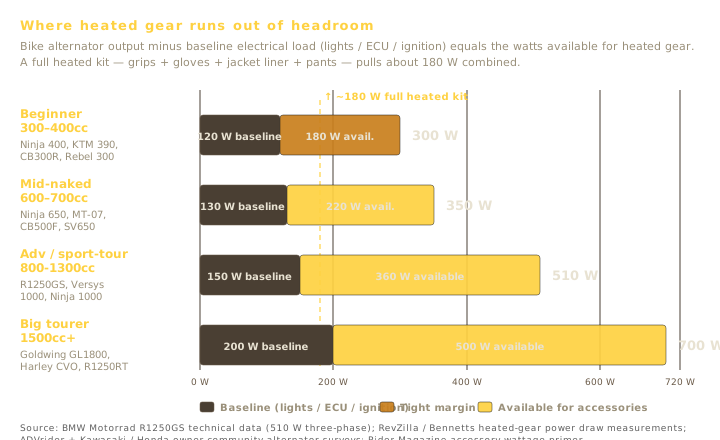
The math, made explicit. Every motorcycle alternator (technically a stator) has a maximum continuous output rated in watts. From that total, the engine's own systems — headlight, taillight, instrument cluster, fuel injection, ECU, ignition coils — consume about 100 to 150 watts on a modern bike (Rider Magazine accessory wattage primer). What's left is the budget for accessories — heated gear, USB chargers, auxiliary lights, GPS, intercom amplifier.
Real alternator outputs (verified):
- 01BMW R1250GS (2018–2023): 510 W (36 A @ 14V).Three-phase alternator, per BMW Motorrad's published R1250GS Adventure technical data. Assuming the standard-equipment baseline of ~150 W (headlight + LED running lights + ECU + ignition + fuel injection — no radar on the 1250), about 360 watts available — comfortably runs the full 4-piece kit plus aux lights plus heated seat.
- 02BMW R1300 GS (2024+): 650 W three-phase.BMW redesigned the boxer charging system for the 2024 R1300 GS — alternator now 650 W nominal, per BMW Motorrad's published R1300 GS technical data. On paper that's +140 W headroom over the R1250 GS, but the 1300 also ships standard with radar (front + rear), a larger TFT, and an LED matrix headlight — baseline jumps to ~250–300 W on a fully-loaded 1300 GS, leaving ~350–400 W available. Net effect: similar real-world headroom to the 1250 GS, with the radar / display power budgeted in. Numbers in third-party reviews vary by which standard-equipment baseline the writer assumes — if you see a different surplus quoted elsewhere in the cluster, the 650 W total is the BMW-published anchor; the surplus depends on which options are on the bike.
- 03Kawasaki Ninja 650 / Z650: ~350 W (24 A @ 14V).Per Kawasaki Rider Forum measurements. After baseline (~130 W), about 220 watts available — runs the 4-piece kit with ~40 W of headroom for one small accessory, or a 3-piece kit (skip the pants) with ~90 W of comfortable margin. Multiple owners have run Tourmaster heated jacket liner + heated gloves successfully while keeping RPMs above 4000.
- 04Honda CB500 / CBR500R: ~280-500 W (varies by RPM).Stator output ramps with engine speed — about 280 W at idle, climbing to 500 W at 5000 RPM per Honda CBR500 Riders Forum analysis. There's a 7.5 A (90 W) accessory line under the seat sized for OEM heated grips. Don't exceed it.
- 05Yamaha MT-07 / FZ-07: estimated ~350 W (not officially published).Yamaha doesn't publish a stator output spec for the MT-07. Owner-community measurements suggest it's in the same ~350 W range as the Ninja 650. Treat like a Ninja 650 budget until Yamaha publishes a number.
- 06Beginner sportbikes (Ninja 400, R3, RC390, CB300R): ~280-320 W.Small parallel-twin and single-cylinder engines have smaller stators. After baseline (~120 W), about 180 watts available — exactly the heated-kit number with zero margin. Heated grips + heated jacket vest (90W combined) is achievable; full kit with heated gloves + pants is on the edge.
- 07Big tourers (Honda Goldwing, BMW R1250RT, Harley CVO touring): 700+ W.Designed from the factory for heated grips + heated seats + aux lights + audio + GPS amplifier + intercom power. 500+ watts available after baseline. Heated kit is not a constraint.
The buying rule, by kit size. A 350 W+ stator (most 600cc+) fits the 4-piece kit (~180 W) comfortably. A 280–350 W stator (Ninja 650, MT-07, CB500F, SV650) fits the 3-piece kit (grips + gloves + jacket liner ≈ 130 W) with margin, or the 4-piece kit at the edge. A sub-300 W stator (Ninja 400, KTM 390, CB300R, Rebel 300) is too tight for either full kit — cap at heated grips + heated vest (combined ~90 W) to leave headroom for the bike itself and the unavoidable accessory creep (USB charging, headset amplifier). If you don't know your bike's stator output, install a $30 voltmeter on the dash and monitor — voltage stays at 13.8-14.5 V when the system has margin; voltage drops below 13.0 V under load when you've exceeded available wattage.
Wiring kit + controllers: the unglamorous middle layer
Heated gear needs three wiring components most buyer guides skip: a switched 12V tap on the bike, a fuse for each accessory circuit, and a controller that dials heat up/down. Skip them and the gear works exactly until the battery dies. Get them right and the kit runs cleanly for years.
- 01Fuse block (US$60-90).Eastern Beaver PC-8 (Japanese plug-and-play, 8 circuits, ~US$75) or Centech AP-1 (US-made, BMW community standard, 6 circuits) are the canonical aftermarket fuse blocks. Critical if you're running more than one accessory — gives each device its own fuse and a clean ignition-switched power source, instead of daisy-chained spaghetti behind the bike's fairing.
- 02Controller (US$50-150).Gerbing makes a dual-zone temperature controller that adjusts jacket liner heat independently from glove heat — useful because your torso needs less heat than your hands at 30-mph cruising. Warm & Safe and Powerlet make similar dual-zone units. Single-zone controllers (one knob, one circuit) work fine for a single piece of gear and cost less.
- 03Plug standards (Powerlet vs SAE vs coax).Heated gear uses 2.5mm coaxial plugs as the connector standard. Battery tenders use SAE 2-pin plugs. Bikes with OEM heated grips often use BMW-style 12V (Powerlet) sockets. Adapters between all three exist — the Powerlet PAC-038 coax-to-SAE adapter is the canonical one. Buy whatever your gear uses; adapt the bike side, not the gear side.
- 04Voltmeter (US$25-50).An Aerostich waterproof digital voltmeter on the dash tells you immediately if heated gear is exceeding available alternator output. Voltage stays at 13.8-14.5 V with margin; drops below 13.0 V when overloaded. The cheapest insurance against being stranded with a flat battery.
Balaclavas, neck warmers, heated socks
The four small pieces that complete the kit. Each costs under US$50, none of them draws any electrical power, and skipping any one of them leaves a cold gap that ruins the whole stack.
| Pick | Use case | Lowest US price |
|---|---|---|
| Six2 BT SCXL V2 Balaclava | Helmet liner — head + neck coverage | US$20 (Motostorm) |
| Dane Saksun Pro Balaclava | Premium moisture-wicking balaclava | US$45 (Motostorm) |
| Alpinestars Neck Warmer | Bridges helmet bottom and jacket collar | US$25 (Alpinestars US) |
| Klim Aggressor Vented Socks | Riding-specific moisture-wicking sock | US$25 (RevZilla) |
| BlackStrap The Hood Balaclava | Skiing-brand balaclava popular with moto riders | US$35 (BlackStrap) |
The BlackStrap Hood is a snowboard-brand piece that rides better than most moto-specific balaclavas. Hinged jaw construction — you can wear it covering the whole face, hinged down to expose mouth, or pulled off to leave only the neck. Lens-safe fabric (doesn't smear visor or sunglasses). Quick-dry, odor-resistant treatment. The trade vs Six2 or Dane: the BlackStrap is one-piece (no separate neck warmer); Six2 + Alpinestars Neck Warmer combined gives you a balaclava + neck warmer set for similar money with slightly more layering flexibility.
Cold-weather kit total budget
Three tiers, like the beginner gear kit — the difference is mostly whether you go bike-powered (more permanent install, lower per-ride cost) or battery-powered (no install, higher per-ride friction). Every item links to a live ALLR product page where available.
| Tier | What's in the kit | Total |
|---|---|---|
| Entry (US$400) | Klim Aggressor 1.0 base layer (US$120) + Klim Inferno fleece (US$110) + KOSO Apollo heated grips (US$130) + Alpinestars Neck Warmer + Six2 balaclava (US$45) | US$405 |
| Mid (US$700) | Entry kit + FirstGear Gen 4 Heated Jacket Liner (US$225) + Eastern Beaver fuse block (US$75) | US$705 |
| Full (US$1,200) | Mid kit + Gerbing 12V G4 Heated Gloves (US$160) + Gerbing 12V Heated Pant Liner (US$249) + Aerostich Voltmeter (US$30) | US$1,144 |
What you get for each tier upgrade. Entry kit (US$400) covers daily commute down to about 40°F — heated grips solve fingertip cold; base + mid layers handle the rest. Mid kit (US$700) adds the heated jacket liner that brings the comfortable temperature floor down to about 25°F. Full kit (US$1,200) adds heated gloves + heated pant liner to push the floor below freezing, plus the voltmeter that warns you when you've exceeded the bike's wattage budget. Below 15°F, even the full kit is challenging — that's the territory where multi-day heated touring gear (electric heated insoles, USB-rechargeable hand warmers) starts to matter.
Buying sequence by climate
The order to assemble the kit depends on how cold your coldest ride is. Spend money on the pieces that close YOUR climate's gap, not the textbook order.
- 01Step 1 (50-65°F coldest day): base layer + mid layer.Klim Aggressor 1.0 long sleeve top + Klim Inferno fleece. About US$230 combined. This stack alone extends a 3-season jacket comfortably 10-15°F colder than just wearing it with a t-shirt underneath.
- 02Step 2 (40-50°F coldest day): add heated grips.KOSO Apollo or Oxford HotGrips Pro. About US$130-200. Heated grips solve the single coldest point on the bike (fingertips at the front of the airflow) at a fraction the cost of full heated gloves. Most riders stop here for moderate climates.
- 03Step 3 (30-40°F coldest day): add heated jacket liner.FirstGear Gen 4 or Gerbing 12V Heated Jacket Liner 2.0. About US$225-280. Pairs with the existing mid-layer fleece — fleece provides insulation, liner provides heat. Together they keep the torso warm down to about 25-30°F.
- 04Step 4 (25-30°F coldest day): add heated gloves.Gerbing 12V G4 (if jacket liner is also Gerbing — they share the same connector and dual-zone controller) or battery-powered alternatives like Klim Resistor HTD. US$160-350. The hands lose heat fastest in airflow; below 30°F heated grips alone aren't enough.
- 05Step 5 (below 25°F coldest day): add heated pant liner + voltmeter.Gerbing 12V Heated Pant Liner + Aerostich voltmeter. US$280 combined. By this point the kit pulls 150-180 W combined — install the voltmeter to confirm the bike's alternator is keeping up.
Common questions
Can I run a full heated kit on a 300-400cc beginner bike?
Why do heated gloves run on 7V or 12V — are they different products?
Do I need a fuse block, or can I run heated gear straight off the battery?
Is the Aerostich Kanetsu vest really worth US$247 vs a US$225 Gerbing liner?
Are battery-powered (7V) heated gloves enough for serious cold-weather riding?
How long do heated gear heating elements last? Is this a one-season investment or a 5+ year investment?
Can I use ski / snowboard heated gear on a motorcycle?
What ALLR does about it
Every heated gear product linked in this article has a live ALLR product page with cross-retailer pricing for your country — including specialty brands like Gerbing, FirstGear, Klim, and Aerostich that only ship from a handful of retailers. The 'lowest US price' columns in the tables above are the current best in-stock landed prices we track. Prices and stock update twice daily as our scrapers re-pull retailer catalogs.
Two limits worth flagging. (1) Heated gear stock fluctuates seasonally — by mid-summer many liners and gloves go out of stock as retailers run down inventory before the fall restock. Buy early (September) for best selection; the alternative is paying a premium at REI / RevZilla in January when stock is at year-low. (2) Wattage specs on heated gear are not always advertised — manufacturers publish them inconsistently. The numbers in this article are sourced from manufacturer pages, third-party tests, or community measurements where the manufacturer doesn't publish; the Aerostich Kanetsu (45 W) and Gerbing 12V Heated Jacket Liner 2.0 (77 W) are the two most-rigorously-tested data points. Treat ±10% margin on the wattage numbers as normal.
We at ALLR exist because motorcycle gear is one of the few large retail categories where cross-retailer pricing isn't surfaced anywhere. Heated gear is the most extreme version of that problem — the same Gerbing 12V G4 Heated Gloves are US$160 at one retailer and US$220 at another (a 37% spread on a single SKU), but you'd have to know to check both. Every link in this article is a starting point — find the size, the colorway, the retailer with stock for your country, and the cold-weather kit comes together for the budget you have.
This guide is part of the motorcycle gear buying playbook. The hub is the canonical sequence — start there if you want the orienting map across all the topic-deep guides our editorial team maintains, in the order each one becomes relevant in the buyer journey.