Motorcycle helmet certifications, decoded
DOT is American self-certification with no rotational impact testing. ECE 22.06 is the European mandate from 2024, with rotational impact at 8.5 m/s. Snell M2025 just closed Snell's long-standing rotational gap. FIM is racing-only. There's no single 'best' cert — here's what each one actually tests, which helmets carry which combinations, and where you can legally ride with each.
Most riders ask whether ECE 22.06, DOT, or Snell is the 'best' helmet certification. The honest answer is that they're four different tests measuring four different scenarios — there's no single best. ECE 22.06 (Europe, mandatory January 2024) tests rotational impact at 8.5 m/s on top of three linear-impact velocities. DOT FMVSS 218 (United States, structurally unchanged since the 1970s) is linear-impact only, with manufacturers self-certifying and NHTSA auditing after the fact. Snell M2020 is voluntary, historically tested at higher energies than ECE or DOT, and the brand-new Snell M2025 just added oblique-impact testing — closing the rotational gap that ECE 22.06 had held for two years. FIM FRHPhe-02 is racing-only and becomes mandatory for FIM international competition on 1 January 2026. We at ALLR track which combinations the current helmets carry, so you can match the cert to your use case rather than chase a mythical 'safest' sticker.
ECE 22.06 — the European mandate (2024–present)
ECE 22.06 is the United Nations Economic Commission for Europe's helmet standard, replacing the 25-year-old ECE 22.05. Manufacturers could not certify new helmet models under 22.05 after July 2022, and as of 1 January 2024 no new ECE 22.05 helmets may be sold new in any ECE-signatory country (which includes the EU, the UK, Japan, Australia, and many others). Existing 22.05 helmets you already own remain legal to wear indefinitely — the mandate restricts new sales, not continued use. See 24Helmets.de's ECE 22.06 explainer for the rollout timeline.
- 01Rotational impact test (new in 22.06).An angled 'bar anvil' set 15° from vertical, covered in 80-grit aluminum-oxide abrasive paper, is struck at 8.0–8.5 m/s. The headform inside the helmet is measured for rotational acceleration; the pass threshold is approximately 10,400 rad/s². This test addresses the rotational injuries (diffuse axonal injury, subdural hematoma) that linear-impact-only standards never measured. See RideApart's ECE 22.06 deep-dive for the full procedure.
- 02Three impact velocities instead of one.22.05 tested linear impacts at a single 7.5 m/s. 22.06 tests at low (6.0 m/s, simulating secondary impacts), medium (7.5 m/s, carried over from 22.05), and high (8.2 m/s, simulating high-speed crashes). The three-velocity regime acknowledges that a helmet faces different impact scenarios on the same ride.
- 03Three times the impact points.22.05 tested 6 impact events per sample. 22.06 expands to roughly 18 impact events drawn from a pool of 12 predetermined plus randomly selected sites — meaning a 22.06-certified helmet has been struck and tested at three times the number of points its 22.05 predecessor was. See SMK's 22.05 vs 22.06 comparison for the test-point breakdown.
- 04Modular helmets must pass in both positions (P/J marking).A modular helmet must now be tested both with the chin bar closed (P, for 'protective') and with it open or removed (J, for 'jet'/open-face) to earn dual P/J homologation. A modular sold with only P approval is legally not allowed to be ridden with the chin bar raised. Modulars without J approval get an NP ('non-protective') marking on the chin bar with a warning that it must remain closed during riding. See Caberg's P/J/NP guide for the marking system.
- 05Accessory homologation.Sun visors are now tested separately for optical distortion, scratch resistance, and refraction. Bluetooth communication systems must be homologated with the specific helmet model — fitting a Cardo or Sena from the brand's universal-mount kit technically voids the homologation unless that exact combination is on the manufacturer's approved-accessory list.
- 06Stronger chinstrap retention.Tested with 10 kg drop weights from 0.5 m (retention) and 0.75 m (stretch/damage). The retention threshold is approximately 3 kN of tension. Modular helmets must pass in both P and J configurations.
DOT FMVSS 218 — the American baseline (1974–present)
DOT certification refers to the United States Federal Motor Vehicle Safety Standard 218, which became effective on 1 March 1974 under 49 CFR 571.218. Two procedural facts matter for a buyer: DOT is self-certified by the manufacturer (no third-party laboratory approves a helmet before sale), and the standard's structural test regime has not been substantively updated since minor amendments in 1980 and 1988. The NHTSA Test Procedure TP-218-07 is the current public reference for the actual test methodology.
- 01Linear impact at two anvil shapes.Flat anvil at 6.0 m/s and hemispherical anvil at 5.2 m/s. Each impact location is struck twice consecutively. The headform's peak acceleration must not exceed 400 g, and certain duration thresholds apply to the deceleration waveform. These velocities are slower than ECE 22.06's medium (7.5 m/s) and high (8.2 m/s) tests.
- 02Penetration test.A 3 kg pointed striker is dropped from approximately 3 m (~7.7 m/s impact velocity) onto specified locations on the helmet shell. The striker must not contact the headform inside. This is a more direct sharp-object test than ECE has, and it's a real consideration in the real world — debris on the highway.
- 03Chinstrap retention.A 38.5 kg weight is dropped on the fastened chinstrap; permanent strap elongation must remain below 1 inch (~25 mm). Comparable to ECE's retention test in concept, lower energy in execution.
- 04Peripheral vision.The helmet must allow a minimum field of view of 105° to either side of the rider's straight-ahead line. (A nominal requirement — every street helmet meets this.)
- 05Self-certification (the controversial bit).DOT compliance is attested by the manufacturer; no pre-market third-party lab signs off. NHTSA performs random post-market compliance testing on samples purchased from retailers and can issue recalls and impose fines for non-compliant helmets. This system has caught counterfeit DOT stickers (the 'Skid Lid' lid-style helmets in particular) but does not catch every borderline-compliant product before it reaches buyers. See LegalClarity's FMVSS 218 explainer for how the audit cycle actually works.
- 06What FMVSS 218 does not test.Rotational impact (no oblique anvil). High-speed linear impacts (capped at 6.0 m/s). Modular position testing (the helmet is tested in one configuration). The standard's age is the standard's main criticism — it predates the brain-injury research that justifies ECE 22.06's rotational test.
Snell M2020 (and M2025) — the voluntary racing standard
The Snell Memorial Foundation is a non-profit US-based helmet-testing body. Manufacturers pay Snell to test and certify their helmets; the cert is voluntary, no jurisdiction mandates it, and the standard updates every five years. M2020 took effect on 1 October 2019, replacing M2015. M2025 was issued by Snell in November 2023 and is being rolled out to new helmet models through late 2025 — the major addition is an oblique (rotational) impact test, which closes Snell's long-standing gap versus ECE 22.06. See webBikeWorld's Snell M2020 review for the M2020 background and Snell's M2025D certification list for the currently certified M2025 models.
- 01M2020D vs M2020R (the split).M2020D ('D' for DOT-aligned) keeps the M2015 impact regime: flat and hemispherical anvils at 7.75 m/s. Hard shell, no oblique testing. M2020R ('R' for ECE-aligned) softens the impact threshold slightly to allow a less stiff shell, and tests at flat 8.2 m/s plus hemispherical 7.70 m/s. M2020R was already broadly comparable to ECE 22.06 minus the rotational test; M2025R adds rotational.
- 02Higher impact energy than DOT or ECE on the flat anvil.Snell tests at 7.75–8.2 m/s on flat anvils versus DOT's 6.0 m/s and ECE 22.06's 8.2 m/s high test. The flat-anvil impact energy is comparable to ECE 22.06's hardest hit. Historically this required a stiffer shell — which is why Snell helmets have traditionally weighed 100–200 g more than ECE-only helmets in the same size.
- 03M2025 closes the rotational gap.M2025 (released November 2023) adds an oblique-impact test similar in concept to ECE 22.06's bar-anvil test. This is the headline change in 30 years of Snell standards. As of mid-2026 the helmets carrying M2025 are mostly new high-end racing models from Arai and Shoei; broad rollout across the industry will take through 2027. M2020D and M2020R helmets remain legitimate — they just don't carry the rotational-impact testing M2025 adds.
- 04Voluntary, racing-adjacent.Snell certification is not mandated anywhere for street use. Some US club racing series (WERA, MotoAmerica club programs, AMA-sanctioned events) require Snell as a minimum for track entry; check the rulebook of the specific organization. For pure street riding in any country, a Snell sticker is a confidence signal, not a legal requirement.
FIM FRHPhe-02 — the international racing cert
FIM (the Fédération Internationale de Motocyclisme, motorcycle racing's world governing body) introduced its Racing Homologation Programme for Helmets in 2019 (FRHPhe-01) and is rolling out Phase 2 (FRHPhe-02) as the mandatory standard for all FIM international competition — MotoGP, World Superbike, Endurance World Championship — from 1 January 2026. The cert is built on top of ECE 22.06: a helmet must already be ECE 22.06-P (or Snell M2020D/R, M2015, or JIS T8133 Type 2 Full Face) before FIM tests it. See FIM's FRHPhe-02 launch announcement for the official scope.
- 01Higher impact velocity and a stricter anvil mix.FIM tests 4 impacts drawn from 17 possible points at 8.2 m/s — versus ECE 22.06's 3 of 12 — and adds a larger slanted anvil and an additional hemispherical anvil specifically for rotational testing. The energy and the coverage are both meaningfully harder than ECE 22.06 alone.
- 02Skull Fracture Criterion (SFC).FIM measures a skull-fracture metric not present in ECE 22.06, derived from peak force and impact duration combined. The pass threshold is set conservatively, which is why few helmets earn FIM and many ECE-22.06-passing helmets fail FIM.
- 03Quick-removal cheek-pad test.The helmet must be removable from the rider's head by track marshals without bending the cervical spine — a real-world consideration for crashed-rider extraction. Most racing helmets already meet this, but FIM verifies it as part of homologation.
- 04Do you need a FIM helmet?.Almost certainly not. FIM is required for FIM-sanctioned international racing only. National-level club racing, trackdays, and street riding follow local federation rules and most do not require FIM. If you race a club series or do trackdays, check the specific organization's rulebook — some progressive clubs are starting to accept FIM as a Snell-equivalent, but FIM is not universal. For street use, the cert is a confidence signal at the highest end of the market, not a legal requirement.
The certification myths to drop in 2026
Three things you'll read in older helmet-buying guides that are outdated, exaggerated, or wrong in 2026:
- 01Myth: 'Snell is the gold standard, ECE is European-lite'.Outdated. ECE 22.06 has tested rotational impact since 2022 and tests at three linear-impact velocities (6.0 / 7.5 / 8.2 m/s) across roughly 18 impact events per sample. Snell M2020D and M2020R test at higher peak energy on the flat anvil but only six impact events and (until M2025) no rotational testing. The two cert regimes test different scenarios well; calling either one 'the gold standard' in 2026 misses where the real differences are. M2025 narrows the gap further by adding an oblique-impact test of its own.
- 02Myth: 'A DOT-only helmet is unsafe'.Overstated. DOT FMVSS 218 has real shortcomings — no rotational test, self-certification, capped impact velocity at 6.0 m/s — but a properly DOT-compliant helmet from a reputable manufacturer (Bell, Arai, Shoei, AGV, Alpinestars, HJC) is engineered to handle the same crash scenarios as an ECE 22.06 helmet because the manufacturer designs to the stricter standard worldwide. The genuine risk is counterfeit DOT stickers on novelty 'lid-style' helmets sold cheaply — those fail every standard. For mainstream brand-name helmets the DOT label is a low bar that's reliably met.
- 03Myth: 'You need Snell for trackdays'.Almost always wrong. Most US trackday organizations require DOT or Snell at minimum; many now also accept ECE 22.06 as Snell-equivalent. Only a minority of club racing series (WERA and a few AMA-sanctioned club programs) require Snell specifically. Check your specific organization's rulebook before assuming. For pure street riding, the Snell sticker buys peace of mind, not legal compliance.
Where each certification is legally required
If you ride across borders or buy helmets from foreign retailers, the cert you have determines where you can legally use the helmet:
| Country / region | Required cert | What about other certs? |
|---|---|---|
| United States | DOT FMVSS 218 | ECE-only helmet is technically non-compliant for street use under federal law. State enforcement varies — many officers will not check; some will. Snell is voluntary, not a legal substitute. See Alpinestars' ECE-vs-DOT overview. |
| Canada | Varies by province | Most provinces (Ontario, BC, Alberta, Quebec) accept DOT, ECE 22.05/22.06, or Snell. A few specify DOT only — check your provincial Motor Vehicle Act. See MotoSport's Canadian helmet-law overview. |
| United Kingdom | ECE 22.05 or ECE 22.06 | DOT-only or Snell-only helmet is not legal for road use. UK has its own SHARP rating on top of ECE as an advisory consumer-information system, not a legal requirement. |
| European Union | ECE 22.05 or ECE 22.06 | DOT-only is not legal. ECE 22.05 helmets you already owned before January 2024 remain legal to wear; only new sales of 22.05 are restricted. New helmets sold must be 22.06. |
| Australia / New Zealand | AS/NZS 1698 or ECE 22.05/22.06 (varies by state) | Australia's AS/NZS 1698 is the historical national standard; most states now also accept ECE. Check your specific state's regulation. |
| Japan | JIS T8133 or ECE 22.06 (PSC mark) | Domestic Japanese helmets carry JIS; imports increasingly carry the PSC mark added to ECE 22.06 certification. |
| FIM international racing | FIM FRHPhe-02 (from 1 Jan 2026) | Mandatory for MotoGP, World Superbike, Endurance World Championship. National-level club racing follows local federation rules. |
Cross-border buyers should check the retailer's return policy before ordering — a US-spec helmet purchased from a US retailer may not carry ECE 22.06, and conversely an EU-spec helmet may lack a DOT label. We at ALLR flag the cert each retailer lists on every helmet PDP.
Which certifications current helmets carry
The certification table below maps the helmet models we track most closely to their actual cert combinations. Cert details on a specific helmet can vary by region (US versus EU versions of the same nameplate are sometimes tested to different combinations), so verify the spec sheet at purchase. Where a model has both a 'street' and a 'racing' variant under the same name, we've listed the dominant production variant.
| Helmet | DOT | ECE 22.06 | Snell | FIM |
|---|---|---|---|---|
| Alpinestars Supertech R10 | Yes (US version) | Yes | — | FRHPhe-02 |
| AGV Pista GP RR Racing #2 | Yes | Yes | — | FRHPhe-02 |
| Shoei X-Fifteen (street version) | Yes | Yes | M2020R | — (separate FIM-spec version exists) |
| HJC RPHA 1N | Yes | Yes | — | FRHPhe-01 |
| Shoei RF-1400 | Yes | Yes | M2020R | — |
| Arai Corsair-X | Yes | — | M2020D (current US production); M2015 on older retail inventory still legitimate | — |
| Arai Signet-X | Yes | — | M2020 | — |
| Arai RX-7V EVO (EU sibling of Corsair-X) | — | Yes | M2020R | FRHPhe-01 (select sizes) |
| Shoei GT-Air 2 | Yes | Yes | — | — |
| Klim Krios Pro | Yes | Yes | — | — |
| Schuberth C5 | Yes | Yes | — | — |
| AGV K6 | Yes | Yes | — | — |
| HJC RPHA 11 Pro | Yes | Yes | M2020 (older production carried M2015) | — |
| Bell Race Star Flex DLX | Yes | — | M2020D | — |
Three patterns worth flagging in the table. (1) The Snell-plus-ECE-22.06-plus-DOT combination on a single helmet is rarer than buyers assume — Shoei RF-1400 and Shoei X-Fifteen are the obvious all-three picks, and the X-Fifteen carries M2020R. (2) Several flagship racing helmets (Alpinestars Supertech R10, AGV Pista GP RR Racing #2, HJC RPHA 1N) carry FIM but skip Snell — FIM's regime is stricter than Snell's M2020 on rotational, so the brands prioritize FIM for race-tier marketing. (3) Arai's US lineup notably skips ECE 22.06 — Arai sells distinct US (DOT + Snell) and EU (ECE 22.06 + Snell + sometimes FIM) variants of the same model; buyers shipping a US Arai overseas should know it may not be street-legal in their destination country.
Helmet picks by certification profile
If you know which cert combination matters most for your use case, these are the strongest representatives currently in our catalog. Browse the full helmet inventory on the /catalog/helmets page; the picks below are the best-known specimens of each cert profile.
Triple-cert (DOT + ECE 22.06 + Snell): the Shoei RF-1400 (about US$579) is the high-volume street/sport flagship and the default safe choice — DOT for US legality, ECE 22.06 for cross-border use, Snell M2020R for the higher-energy testing. The Shoei X-Fifteen carries the same trio with a sportier shell.
Cross-border touring (DOT + ECE 22.06, no Snell): the Klim Krios Pro (about US$700) is the dual-cert adventure-touring choice. The Schuberth C5 (about US$750) is the modular alternative for round-oval heads. The AGV K6 (about US$500) is the lightweight sport-touring pick. The Shoei GT-Air 2 (about US$700) is the integrated-sun-visor touring choice. None carry Snell — for street and ADV use this is fine; FIM is overkill.
Racing-tier (DOT + ECE 22.06 + FIM, no Snell): the Alpinestars Supertech R10 (about US$1,099) is the modern FIM-spec choice — carries FRHPhe-02 for international race compliance, ECE 22.06 for road legality outside racing, DOT for US street use. AGV Pista GP RR Racing #2 is the AGV equivalent. HJC RPHA 1N is the value FIM-tier helmet, with FRHPhe-01. None carry Snell — for FIM-tier helmets the more demanding FIM cert is the focus.
US-spec racing (DOT + Snell, no ECE 22.06): the Arai Corsair-X (about US$900–1,100) is the canonical American racing helmet — Snell M2020 on the newest production, hand-built with Arai's traditional construction. Buyers who want both Snell and ECE 22.06 should look at Arai's EU-spec RX-7V EVO instead.
The 60-second cert check on any helmet you're considering
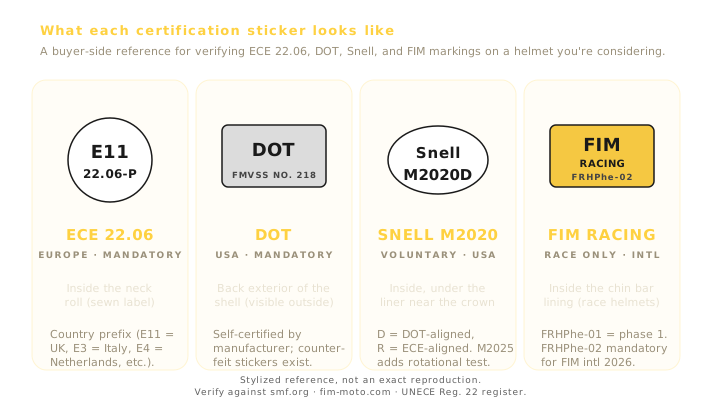
All four certification stickers are visible to a buyer who knows where to look. Three live inside the helmet, one is on the back exterior of the shell. The visual below shows what each one looks like and where on the helmet to find it:
Step-by-step verification
- 01Find the back-of-shell label.Every road-legal helmet has a manufacturer's label inside the shell near the back of the neck roll. Look for the ECE roundel ('E' followed by a country code in a circle), the DOT sticker on the back exterior of the shell, the Snell roundel inside, and any FIM marking. A counterfeit DOT sticker is the most common cert fraud — if the sticker looks rough or peels easily, the helmet is suspect.
- 02Check the ECE roundel suffix.An ECE 22.06 roundel ends in '06' (e.g., 'E11-22.06-P'). The leading letter and number identify the testing country (E11 = UK, E3 = Italy, E4 = Netherlands, E13 = Luxembourg, etc.). The '-P' or '-J' suffix tells you the P/J homologation status for modulars.
- 03Look up the Snell cert list directly.Snell publishes per-standard certification lists on smf.org/certlist — search the helmet model name to confirm Snell certification rather than trusting the listing alone. Helmets without an entry on the list are not Snell-certified, regardless of marketing copy.
- 04Verify FIM status on the FIM list (if claimed).FIM publishes the homologated-helmet list on fim-moto.com. A 'FIM Racing' or 'FRHPhe-02' callout on the retail page should match the FIM list — if it doesn't, the helmet may carry FRHPhe-01 (older) or no FIM cert at all.
- 05Check the manufacturer spec sheet for region-specific variants.Arai, Shoei, HJC, AGV all sell distinct US-spec and EU-spec versions of the same nameplate. The US helmet typically carries DOT + Snell; the EU helmet typically carries ECE 22.06 + (sometimes) Snell. Verify before importing — a US-spec Arai shipped to a European address may not be legal to ride there.
Common questions
Is ECE 22.06 safer than DOT?
Can I ride in the United States with an ECE-22.06-only helmet?
Can I ride in Europe with a DOT-only helmet?
Why are Snell-certified helmets heavier?
Do I need a FIM-certified helmet for trackdays?
Is my old ECE 22.05 helmet still legal to wear after January 2024?
What's the difference between Snell M2020D and M2020R?
Does Snell M2025 make M2020 helmets obsolete?
What ALLR does about it
Every helmet product page on ALLR shows the cert combination the manufacturer publishes for that specific model and region. Our /catalog/helmets page lets you filter by brand, and the per-PDP spec section is where we surface the cert detail — including whether a helmet carries ECE 22.06 or only the older 22.05 sticker, whether it's Snell M2020D or M2020R, and whether the FIM homologation is FRHPhe-01 or the newer FRHPhe-02.
Two limits we're honest about. (1) Some manufacturer spec sheets are ambiguous about which Snell or FIM variant a specific production batch carries — when in doubt, we link to the official cert list (Snell's smf.org/certlist or FIM's helmet list) and recommend verifying before purchase. (2) Region-specific variants of the same model (US-spec Arai Corsair-X versus EU-spec RX-7V EVO) carry different cert combinations; we flag the variant on the product page but cross-border buyers should re-verify against their destination country's requirement.
Certifications are one of the few helmet specs that don't degrade with marketing copy. Either the cert is on the label or it isn't — and on the rare occasions a sticker is counterfeit or misapplied, the official cert lists will tell you within 60 seconds. We at ALLR think the conversation about helmet safety would be better served by 'which cert does this helmet actually carry, and is it the one I need where I ride?' than by the endless 'Snell vs ECE vs DOT' framing that treats the certifications as competitors. They aren't — they're complementary tests, and the right helmet for you is the one carrying the combination your jurisdiction and use case require.
This guide is part of the motorcycle gear buying playbook — the hub is the canonical sequence across all topic-deep guides.