Motorcycle helmet head shapes by brand
Most riders are intermediate oval. Long oval and round oval each get a third of the remaining buyers. Brand choice depends on which shape your skull is — Arai and Shoei lean oval, Schuberth and HJC lean round, AGV sits in the middle. Here's how to figure out your shape and which helmets actually fit it.

Most motorcycle riders — by industry estimate — are intermediate oval, with the head shape slightly longer front-to-back than side-to-side. Long oval (noticeably longer front-to-back) and round oval (nearly equal in both dimensions) split the remaining minority. Brand choice depends on which shape your skull is, because every helmet manufacturer designs around a default shape. Arai's Signet-X line leans long oval. Shoei, AGV, Alpinestars, and Klim sit at intermediate. Schuberth, HJC's i-series, LS2, and Caberg lean round. Buy a round-shaped helmet for an oval head and you'll get forehead pressure points within 20 minutes; buy oval for a round head and you'll feel your temples being squeezed. This guide explains how to figure out your shape, which brands fit which, and how to test fit without a return shipment.
The three head shapes
Helmet manufacturers categorize human skull shapes into three reference classes for design purposes. The shapes aren't about size — your head circumference determines size; your skull's plan-view proportions determine shape. A medium long-oval head and a medium round head both fit a 'medium' helmet, but they fit completely different brands of medium.
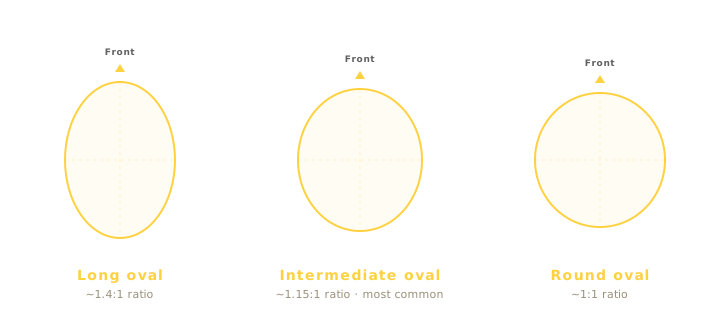
- 01Long oval.Significantly longer front-to-back than side-to-side — a minority of riders. Plan view from above looks like an egg pointing forward. Pressure points form on the sides (temples, above the ears) in helmets designed for rounder shapes. The canonical long-oval helmet is the Arai Signet-X — purpose-designed around the shape — along with some older Shoei moulds. Modern long-oval-specific options are surprisingly rare given that most brands default to intermediate.
- 02Intermediate oval.Slightly longer front-to-back than side-to-side — the default and by far the most common shape (most industry sources estimate roughly 70-80% of riders, see webBikeWorld's helmet reviews sorted by internal shape for cross-brand confirmation). Looks oval in plan view but not aggressively so. Most modern helmets are designed for intermediate oval out of the box: Shoei (RF-series, Neotec, X-Fifteen), Arai Regent-X, AGV K-series and Pista GP-RR, Alpinestars Supertech R10, HJC RPHA 11 Pro, Bell Race Star Flex DLX, Scorpion EXO-R1 Air, Klim Krios Pro (co-developed with 6D, whose internal shape is intermediate).
- 03Round oval.Nearly equal front-to-back and side-to-side — a minority of riders. Plan view looks circular. Pressure points form on the forehead and the back of the head in helmets designed for oval shapes. Brands that build for round oval: Schuberth (C5 modular), HJC's i-series (i70, i90, i100), LS2 (Vector II, Storm II), Caberg, MT, Scorpion EXO modulars, some Nolan modulars.
How to figure out your own head shape
- 01Top-down photo.The most reliable method. Have a friend stand directly above you holding their phone camera flat (parallel to the ground), looking down at the top of your head. Push your hair flat first. Compare the photo to a clock face: is the shape obviously elongated front-to-back (long oval), slightly elongated (intermediate), or roughly circular (round)? Most riders are surprised — what feels like an obvious oval head from the inside often photographs as intermediate.
- 02Tape measurement, two axes.Measure your head's circumference horizontally just above the eyebrows and ears (the helmet-fitment circumference). Then measure two diameters with a soft tape: front-to-back (forehead to occipital bone at the back of the head) and side-to-side (just above the ears). If front-to-back exceeds side-to-side by more than 1 inch (25mm) you're long oval. If they're within 0.5 inch (12mm) you're round. In between is intermediate.
- 03The try-on diagnostic.Try on a helmet from a brand you know is shape-specific (an Arai Regent-X is intermediate, a Schuberth C5 is round, an Arai Signet-X is long oval). Wear it for 15 minutes and note where pressure builds. Forehead pressure + a loose feel at the temples = your head is rounder than the helmet. Temple pressure + a loose feel at forehead/back = your head is more oval than the helmet. No pressure points after 15 minutes = correct shape match. This is the method dealer fit specialists use in-store.
Brand-to-shape map
Every helmet brand designs around a default head shape — even within a single brand's lineup the shape can shift between model families (e.g., Arai's Signet-X is long oval while the Regent-X is intermediate). The table below maps the helmet brands ALLR tracks to their dominant shape. "Lean" means most of the brand's lineup sits in that shape category; "Mixed" means the brand makes models for multiple shapes within its catalog.
| Brand | Dominant shape | Canonical example | Typical price range |
|---|---|---|---|
| Arai | Mixed (long oval + intermediate) | Signet-X (long oval) / Regent-X (intermediate) | US$700 – $1,200 |
| Shoei | Intermediate oval (lean long) | RF-1400 / X-Fifteen / Neotec II | US$500 – $1,000 |
| AGV | Intermediate oval | K6 S / Pista GP-RR / Tourmodular | US$400 – $1,700 |
| HJC RPHA series | Intermediate oval | RPHA 11 Pro / RPHA 91 | US$300 – $700 |
| HJC i-series | Round oval | i70 / i90 / i100 | US$150 – $400 |
| Alpinestars | Intermediate oval | Supertech R10 / Supertech M10 | US$700 – $1,100 |
| Bell | Intermediate oval | Race Star Flex DLX / Star DLX MIPS | US$400 – $900 |
| Scorpion EXO-R series | Intermediate oval | EXO-R1 Air / EXO-R420 | US$200 – $600 |
| Scorpion EXO modulars | Round oval | EXO-AT960 / EXO-GT930 | US$200 – $400 |
| Schuberth | Round oval | C5 / S3 / SR2 | US$650 – $1,200 |
| Nolan | Mixed | N100-5 (round) / X-803 (intermediate) | US$300 – $800 |
| X-Lite | Intermediate oval | X-803 RS Ultra Carbon | US$600 – $1,000 |
| LS2 | Round oval | Vector II / Storm II / Citation II | US$120 – $400 |
| Caberg | Round oval | Duke II / Drift Evo II | US$200 – $450 |
| Shark | Intermediate oval | Spartan GT / Skwal i3 | US$300 – $700 |
| Klim | Intermediate oval | Krios Pro (co-developed with 6D) / TK1200 | US$400 – $750 |
| MT | Round oval | Thunder 4 SV / Targo | US$120 – $250 |
| Suomy | Intermediate oval | TX-Pro / SR-Sport | US$250 – $600 |
The table is a starting filter, not a guarantee. Within Shoei's lineup the X-Fifteen leans more oval than the RF-1400; within Arai the Regent-X sits at intermediate while the Signet-X is the long-oval option. When in doubt, look up the specific model on the Helmets category page on ALLR and read the manufacturer's spec sheet for the model's head-shape designation.
Pressure points and what they tell you
After about 15 minutes wearing a helmet, mismatches between your skull and the helmet's interior padding create predictable pressure patterns. The location of the pain tells you exactly what's wrong.
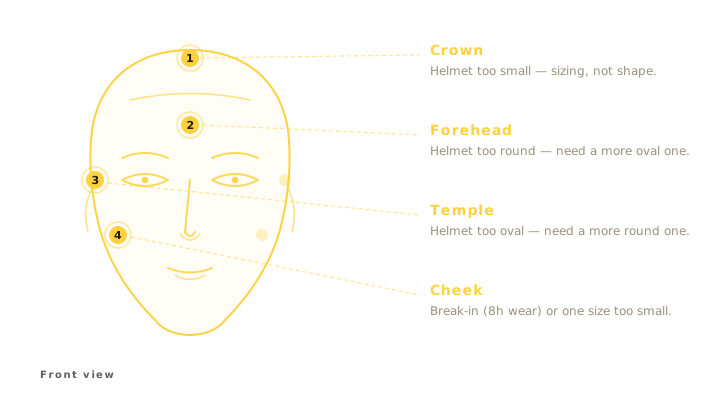
- 01Forehead pressure (front of the head, just above the brow).The helmet is too round for your head — its longest interior axis runs side-to-side while your skull's longest axis runs front-to-back. You need a more oval-shaped helmet (Arai, Shoei, Klim, sometimes AGV).
- 02Temple pressure (sides of the head, just above the ears).The helmet is too oval for your head — its longest interior axis runs front-to-back while your skull is roughly circular. You need a more round-shaped helmet (Schuberth, HJC i-series, LS2, MT, Caberg).
- 03Crown pressure (top of the head, dead center).The helmet is one size too small. This is a sizing problem, not a shape problem. Go up one size in the same model and the crown pressure disappears.
- 04Cheek pressure that fades over a few rides.Cheek pads break in. Mild cheek pressure that's uncomfortable but not painful at first will typically settle into a snug-but-comfortable feel after 8–12 hours of wear. Acute cheek pain on day one means the helmet is genuinely too small or you've gotten the wrong shape — return it.
- 05Loose feel at the back of the head while everything else fits.Your head shape is more oval than the helmet's interior, but only marginally. Some helmets (most Shoeis, most AGVs) include cheek-pad and interior-liner options that shift the fit toward more oval. Check the manufacturer's spare-parts catalog before returning the helmet.
Best helmets per head shape
Within each shape category, pricing tiers offer clear best-in-class picks. Browse the full inventory by category and brand filter on the Helmets catalog page on ALLR; the recommendations below are the strongest representatives of each shape at their price tier.
Long-oval picks: the Arai Signet-X (about US$800–950 in our catalog) is the canonical long-oval helmet, hand-built with a different interior than its intermediate-oval Regent-X sibling. The Arai Corsair-X (about US$900–1,100) — Arai's MotoGP-tier racing helmet — shares the same elongated head-shape philosophy and is more commonly available in colorways. Shoei's older NXR moulds also fit long-oval heads better than the newer RF-1400. Long-oval-specific modern helmets are otherwise scarce — most riders with this shape end up between an Arai (Signet-X or Corsair-X) and used/older Shoei stock.

Intermediate-oval picks: the Shoei RF-1400 (about US$579) is the high-volume best-seller and the default safe choice for a new buyer who doesn't know their shape — intermediate fits the most people. The Shoei GT-Air 2 (about US$700) is the touring-tier alternative with an integrated sun visor. The Arai Regent-X (about US$680) is the slightly-more-premium pick. The Alpinestars Supertech R10 (about US$1,099) is the racing-tier choice. The Klim Krios Pro (about US$700) is the adventure-touring intermediate-oval option with a built-in shield. The AGV K6 (about US$500) and the HJC RPHA 11 Pro (about US$500) are the mid-tier alternatives.

Round-oval picks: the Schuberth C5 modular (about US$750) is the premium round-oval choice — touring-grade with low noise levels and an integrated sun visor. The HJC i90 modular (about US$300) is the mid-tier alternative; the LS2 Vector II (about US$200) is the value pick.

The 30-minute fit test (do this before riding)
- 01Wear it for 30 minutes at home, no riding.Sit on the couch, watch something, leave the helmet on. Most fit problems show up between minutes 15 and 30 — earlier is normal break-in pressure that fades; later is genuine misfit you'll regret on a 2-hour ride.
- 02Check for pressure points.Note any acute pain or pressure points. Forehead = too round. Temples = too oval. Crown = too small. Cheeks = either too small or breaking in (give it 8 hours of wear before deciding).
- 03Grab the chin bar and twist.With the chinstrap fastened, grab the chin bar and try to rotate the helmet on your head. The helmet should move your cheeks — your cheeks should not stay still while the helmet rotates. If the helmet rotates without your cheeks moving, it's too loose.
- 04Lean forward to floor, then look up at the ceiling.The helmet should stay seated. If it slides forward over your eyes when you tip your chin down, or slides back when you look up, the fit is wrong (usually too large, occasionally wrong shape).
- 05Push the chin bar up toward your nose.Hard. The helmet should not roll off your forehead. If it does, the chin bar is too far from your jaw — usually a sizing-down issue, occasionally a shape mismatch.
- 06Decide before the return window closes.Most retailers we track allow 30-day returns on unused helmets, though some EU retailers narrow this to 14 days (REV'IT!, J&S Accessories, RidingGear.ca) and a few (TripleClamp Moto) cap at 7 days. Sale items and helmet liners are often final-sale even within the window. Check the specific retailer's return policy on the product page before ordering — that data is shown on every PDP on ALLR.
Common questions
Are most riders oval or round?
How do I know if I have an oval or round head?
Why does my helmet hurt my forehead?
Which helmet brand fits round heads best?
Which helmet brand fits long oval heads best?
Can I change a helmet's shape by swapping the interior padding?
What ALLR does about it
Every helmet product page on ALLR shows the brand's head-shape designation when the manufacturer publishes one, plus the cross-retailer landed-cost comparison for your buyer country. The /catalog/helmets page filters by brand so you can narrow to oval-leaning brands (Arai, Shoei, Klim) or round-leaning brands (Schuberth, HJC i-series, LS2, MT, Caberg) before you start price-comparing.
Two things we don't do: simulate fit (impossible without trying the helmet on) and predict the shape of a model the manufacturer hasn't publicly designated. About 8% of the helmets in our catalog don't have a published shape — for those, the safe path is to try one on at a local dealer before ordering online. We at ALLR favor helmets with explicit shape designations on the product page because the data lets buyers filter out wrong-shape models before they're stuck with a 30-day return window.
This guide is part of the motorcycle gear buying playbook — the hub is the canonical sequence across all topic-deep guides.