Cardo vs Sena 2026, decoded
Cardo's DMC and Sena's Mesh don't talk to each other — the brand decision is locked in by whatever your riding buddies already own. Cardo's 2026 flagship is the Packtalk Pro; Sena's is the just-released 60S Evo with Bose audio (May 2026). Here's the lineup-by-lineup comparison plus the honest real-world range numbers, the Mesh 3.0 vs 2.0 backward-compat trap, and the Midland budget alternative.

Pick what your riding buddies have. Cardo's DMC mesh and Sena's Mesh 3.0 protocols don't talk to each other — the brand decision is locked in by network effect before any feature comparison matters. If your group rides Cardo, get Cardo. If they ride Sena, get Sena. If you're a solo rider with no group to coordinate with, the answer comes down to which lineup you prefer at your price tier. Cardo's 2026 flagship is the Packtalk Pro (US$459); the Packtalk Edge (US$312) is still in production as the value flagship. Sena's just-released 60S Evo with Bose audio (May 2026) tops the Sena range; the standard Sena 60S with Harman Kardon (US$391) is the current best-available flagship in our catalog. We at ALLR walk both lineups below with honest real-world performance numbers and the small print most reviews skip.
The brand-network reality (read this first)
Both Cardo and Sena use proprietary mesh-networking protocols — Cardo calls theirs DMC (Dynamic Mesh Communication), Sena calls theirs Mesh 3.0. They're functionally similar (mesh topology, auto-rejoin, 1-mile-claimed unit-to-unit range) but they do not interoperate. A Cardo Packtalk Pro and a Sena 60S in the same group cannot mesh together at all.
The fallback is Universal Intercom — a Bluetooth-based bridge that works pair-by-pair (not mesh), drops effective range to 300–500 m, and degrades audio fidelity. Cardo's Universal Intercom supports up to four total connected riders across both brands; Sena's similarly works pair-only. See Bennetts BikeSocial's cross-brand pairing guide for the actual user experience: it's a workaround, not a solution. If you ride with a mixed-brand group, expect lossy audio and one-to-one chains rather than full-group conversation.
There's also a backward-compatibility trap inside Sena's own ecosystem. Mesh 3.0 does not talk to Mesh 2.0 at full feature parity — a 60S has to drop to Mesh 2.0 mode to talk to a 50S/50R/30K, which limits group features. Confirm your riding group's specific model years before assuming all-Sena means all-compatible. Cardo's DMC does not have this generational split — all DMC-capable Cardo units (Bold 2018+, Edge, Neo, Pro) mesh together.
Cardo's 2026 lineup
Cardo's lineup is structurally clear: Spirit at entry, Freecom in the middle, Packtalk at the top. DMC mesh only appears on the Packtalk tier — Spirit and Freecom are Bluetooth-intercom-only. If your group meshes, you need a Packtalk. If you're a solo rider or your group is fine with pair-only Bluetooth, the lower tiers save real money.
| Model | Networking | Audio | Best for | Lowest US price |
|---|---|---|---|---|
| Packtalk Pro | DMC (15 riders, ~5 mi group) | 45 mm JBL | Flagship with crash detection | US$459 MSRP |
| Packtalk Edge | DMC (15 riders, ~5 mi group) | 40 mm JBL | Value-tier flagship still in production | US$312 |
| Packtalk Neo | DMC (15 riders) | 40 mm JBL | Mid-tier mesh without crash detection | US$261 |
| Freecom 4X | Bluetooth (4 riders) | 40 mm JBL | Bluetooth group without mesh — sweet spot for small groups | US$208 |
| Freecom 2X | Bluetooth (2 riders) | Standard | Two-rider partner setup | US$184 |
| Spirit HD | Bluetooth (2 riders) | HD audio | Entry with FM radio and music sharing | US$138 |
| Spirit | Bluetooth (2 riders) | Standard | Entry — solo + occasional partner pairing | US$105 |
The Packtalk Pro vs Edge decision is the one most buyers struggle with. The Pro adds crash detection (auto-call emergency contact in a high-G incident), 45 mm JBL speakers vs Edge's 40 mm, and the longer 8 km group-range claim. The Edge remains a strong value pick at US$60 less if you don't need crash detection — and is the unit most current Cardo riders are on. See Bikerguides' Pro-vs-Edge comparison for the specific feature deltas.
Sena's 2026 lineup
Sena's lineup is busier than Cardo's — the 50-series, 60-series, and budget 5R lines exist side-by-side, with the brand-new 60S Evo (May 2026 release) at the top. Notable structural changes for 2026: Sena's audio partner shifted from Harman Kardon to Bose on the 60S Evo specifically; the standard 60S still ships with Harman Kardon. The 50S and 50R remain Harman Kardon.
| Model | Networking | Audio | Best for | Lowest US price |
|---|---|---|---|---|
| 60S Evo (NEW May 2026) | Mesh 3.0 + Open Mesh + Wave (cellular) + Bluetooth | Sound by Bose | Brand-new flagship; not yet widely tracked | ≈ US$499 MSRP (not in catalog yet) |
| Sena 60S | Mesh 3.0 + Open Mesh + Wave + Bluetooth | Sound by Harman Kardon (2nd gen) | Current best-available flagship | US$391 |
| Sena 60S Dual | Same as 60S, pair | Sound by Harman Kardon | Two-unit set for partner riding | US$501 |
| Sena 50S | Mesh 2.0 + Bluetooth | Sound by Harman Kardon (1st gen) | Older flagship — still capable, mostly sold as a 2-unit pair | Dual pack US$444 |
| Sena 50R | Mesh 2.0 + Bluetooth | Sound by Harman Kardon (1st gen) | Low-profile 50S — flatter against helmet | US$241 |
| Sena 5R | Bluetooth (4 riders) | Standard | Bluetooth-only budget pick | US$125 |
| Sena 5R Lite | Bluetooth (2 riders) | Standard | Two-rider entry | US$98 |
The Bose audio upgrade on the 60S Evo is real, not just marketing. Sound by Bose on the 60S Evo replaces the Harman Kardon 2nd-gen used on the standard 60S; reviews from Motorcycle News note clearer mid-range and meaningfully better bass at highway speeds. Whether the Bose upgrade is worth the ~US$100 over the standard 60S depends on how much music you listen to vs intercom-only riding.
The Mesh 3.0 vs Mesh 2.0 trap (worth re-emphasizing): if you're joining a Sena group that has 50S/50R/30K units, your new 60S/60S Evo will have to drop to Mesh 2.0 mode to talk to them — losing some of the Mesh 3.0 features. There's no way around this; it's a generational protocol split. Confirm your group's units before buying.
Side-by-side: Cardo flagship vs Sena flagship
If you're buying without a group constraint and want the head-to-head between current flagships, here's the comparison. We've used the Cardo Packtalk Edge (US$312) instead of the Packtalk Pro because the Edge is the most-bought current Cardo and represents the actual buying decision most riders face. The Sena 60S (Harman Kardon) is the current best-available Sena in our catalog; the 60S Evo with Bose is too new to track.
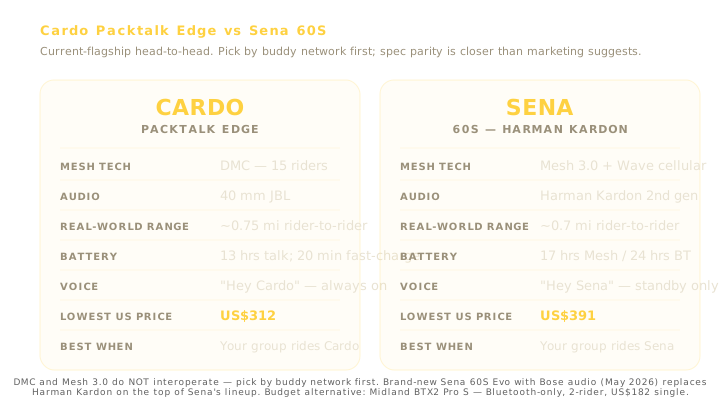
The honest summary: Cardo and Sena are matched on the things that matter. Both mesh up to 15+ riders, both fast-charge to multiple hours of talk time in ~20 minutes, both have credible voice control, both have natural smartphone apps. The differences are at the edges (Sena adds cellular Wave on the 60-series for unlimited-range relay between distant riders; Cardo adds crash detection on the Pro). Your buddy network — not feature parity — should drive the decision.
Real-world range vs marketing
Both brands market their flagships as ~1 mile rider-to-rider. Real-world testing from Ride Adv's Cardo Packtalk Edge review and Motorcycle Mojo's 2025 round-up puts the actual rider-to-rider range at ~0.5–0.75 miles depending on terrain for the Cardo Packtalk Edge (closer to 0.75 mi on open road, closer to 0.5 mi in mountain or canyon). Sena 60S real-world performance is similar per Ultimate Motorcycling's 60S review.
The 5-mile group-range marketing claim only materializes with 3+ riders relaying. A solo pair maxes near the direct rider-to-rider figure (0.5–0.75 mi). If your group is a 2-rider partner setup, you'll never see the marketing-headline range — that's a 4+ rider feature.
For practical riding, both flagships handle the typical urban + canyon + highway use case fine. The range matters more for adventure / dirt-road riding where distance between bikes can stretch quickly, and for large-group rides (5+ riders) where the mesh-relay topology becomes the deciding feature.
The Midland BTX2 Pro S budget alternative
If you're a solo rider who occasionally pairs with one buddy, neither Cardo nor Sena's mesh tier is necessary. Midland's BTX2 Pro S (US$182 single / US$327 twin from our catalog) is a Bluetooth-only intercom that handles 2-rider full-duplex conversation, FM radio, music sharing, and basic phone-call passthrough. It will not mesh with anything else — but if you're never riding in groups, mesh is overkill.
Midland sits in the same Bluetooth-only category as Cardo Spirit HD and Sena 5R, with slightly longer range (the LR — Long Range — variant claims 1.6 km rider-to-rider). The trade-off vs Cardo Spirit HD (US$138) or Sena 5R (US$125): Midland costs slightly more but offers longer-range Bluetooth than either Cardo or Sena's entry-Bluetooth tier. For partner-only riders, all three are valid; pick by app preference and helmet-clamp compatibility with your existing helmet.
What we'd buy
Before buying an intercom, make sure your base safety kit is complete — an intercom is a comfort and group-coordination upgrade, not a safety requirement. See the beginner motorcycle gear kit under $1,000 guide for the helmet + jacket + gloves + pants + boots prerequisite. Once that's covered, the intercom becomes the natural next addition.
If your group rides Cardo: Packtalk Edge at US$312 is the value-flagship answer for most buyers. Step up to Packtalk Pro (~US$459) if you specifically want crash detection. Step down to Packtalk Neo (US$261) if you're newer and the crash-detection-plus-bigger-speakers upgrade isn't worth US$50.
If your group rides Sena: the 60S Harman Kardon at US$391 is the current best-available flagship in our catalog. The 60S Evo with Bose (US$499) is the audio-first upgrade once it's widely stocked. If your group is older-vintage Sena (50S/50R), get a unit that matches their Mesh generation — adding a 60S/60S Evo to a 50-series group means dropping to Mesh 2.0 anyway, so there's less benefit to spending up.
If you're a solo rider with no group constraint: the head-to-head between Cardo Packtalk Edge (US$312) and Sena 60S (US$391) comes down to ecosystem preference. Cardo's app is cleaner; Sena's range topology is slightly more featured (Open Mesh + Wave). Both are excellent.
If you only occasionally ride with one partner: Midland BTX2 Pro S (US$182) or Cardo Spirit HD (US$138) cover 90% of the use case at a third of the flagship price. Mesh is overkill for partner-only riding.
Common questions
Can a Cardo and a Sena talk to each other?
Is the Sena 60S Evo with Bose worth the upgrade over the standard 60S?
Will my new Sena 60S work with my friend's older Sena 50S?
How does battery life compare in real-world riding?
What about voice control — does 'Hey Cardo' / 'Hey Sena' actually work?
Can I use my existing helmet with either brand?
Do I need to mesh at all, or is Bluetooth intercom enough?
Are Cardo and Sena waterproof?
What ALLR does about it
Every Cardo, Sena, and Midland product mentioned here has a live ALLR product page with cross-retailer pricing for your country. The 'lowest US price' columns in this article are current best landed prices from our catalog as of May 2026; click through any link to see all retailers carrying that exact product, sorted by landed cost. Prices update twice daily as our scrapers re-pull catalogs.
Two limits we're honest about. (1) Brand-new units take time to enter our catalog. The Sena 60S Evo with Bose launched in May 2026 and isn't yet stocked across enough retailers we track to surface confident pricing. We'll add it as wider distribution lands. (2) Used / refurbished intercoms are not in our scope. Used Cardo and Sena units circulate on motorcycle forums for 40–60% of new retail; the trade-off is usually worn earpiece cushions and uncertain battery health. We track new + manufacturer-refurbished only.
Intercoms are one of the easier moto categories to cross-shop because the product is the same regardless of who's selling it. Retailer margin varies meaningfully — the same Cardo Packtalk Edge sells from US$300 at one retailer to US$380 at another. We at ALLR exist to surface the actual cheapest landed price across all of it. Pick your brand by buddy network, then let the price comparison decide the retailer.
This guide is part of the motorcycle gear buying playbook — the hub is the canonical sequence across all topic-deep guides.